


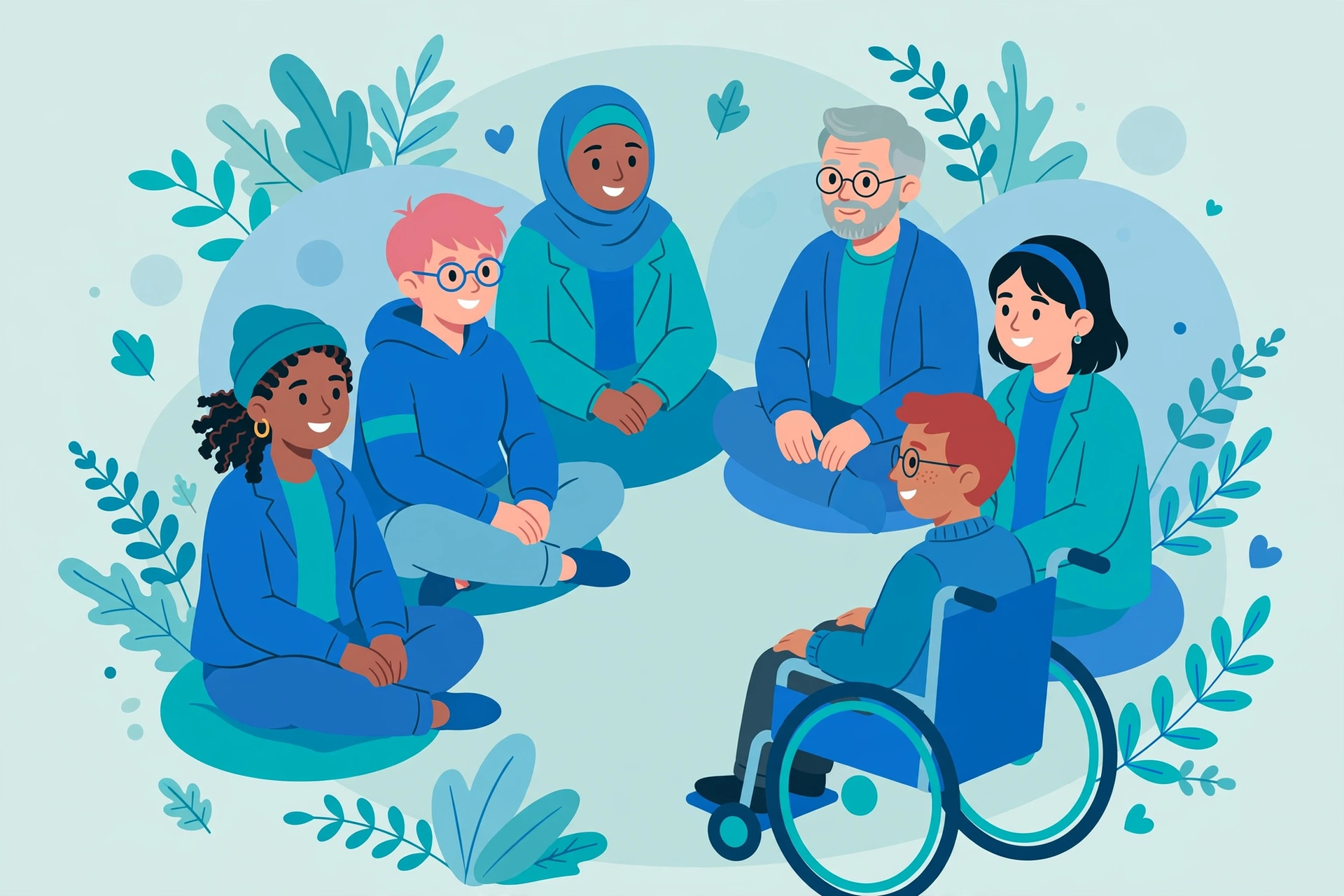
There is a particular kind of relief that comes from sitting in a room — or a video call — with people who simply understand. No explaining, no minimizing, no awkward silence after you say the hard thing out loud. If you have been searching for mental health support groups near you, that relief is closer than you think. This guide walks you through what support groups are, where to find them, and how to choose one where you genuinely feel at home.
Key Points
- Support groups are peer communities for shared experience — they complement, but never replace, professional treatment.
- Free options exist in most cities through nonprofits, hospitals, and community centers; many also meet online.
- The main formats are in-person, online, peer-led, professionally led, and groups focused on a specific condition or life experience.
- It is completely normal to attend your first meeting just to listen — nobody should pressure you to share.
- Try two or three meetings before deciding; the right fit matters more than the first group you find.
- Watch for red flags like medical advice being pushed, no confidentiality norms, or anyone selling a “cure.”
What a Mental Health Support Group Actually Is
A support group is a gathering of people who share a common experience — living with depression, anxiety, grief, bipolar disorder, trauma, or simply the strain of caring for someone who is struggling. Members meet regularly to talk, listen, and encourage one another. Unlike a dinner with friends, everyone in the room arrives with the same unspoken agreement: what is said here stays here, and nobody has to pretend to be okay.
It helps to know what a support group is not. It is not group therapy — that is led by a licensed therapist working toward specific treatment goals. Most support groups are peer-led: the facilitator is someone with lived experience who guides the conversation, not someone who diagnoses or treats. And a support group is not a crisis service — if you are in immediate danger, contact emergency services or a crisis helpline first.
The Main Types of Support Groups
Not all groups look the same, and knowing the landscape makes your search much easier.
In-person groups
These meet at community centers, places of worship, hospitals, or libraries. Face-to-face contact can feel more grounding — you read body language and build real relationships over time. For many people, simply leaving the house and being somewhere on purpose becomes part of the healing.
Online and virtual groups
Video-call groups, moderated forums, and chat communities let you join from home. They are a lifeline if you live far from services, have limited mobility, or feel safer behind a screen at first. Some run around the clock, which matters on the nights when everything feels heavier.
Peer-led vs. professionally led groups
Peer-led groups are run by people who have been through it themselves — the power is mutual understanding. Professionally led groups, run by a counselor or social worker, tend to be more structured and may teach specific coping skills. Neither is better in principle; they simply serve different needs.
Condition-specific and identity-based groups
Some groups focus on one condition, such as depression, anxiety, or grief. Others gather around a shared life experience: new mothers with postpartum depression, students, veterans, or LGBTQ+ people. If a general group feels too broad, a focused one often feels more immediately relevant.
Where to Find Support Groups Near You
Here are the most reliable places to look, starting with the ones that cost nothing.
National directories and nonprofits
Large mental health organizations maintain searchable directories. In the United States, the National Alliance on Mental Illness (NAMI), the Depression and Bipolar Support Alliance (DBSA), and Mental Health America all list local chapters and meeting times. Psychology Today’s directory also includes support groups alongside therapists. In the UK, the Hub of Hope database and local Mind branches serve the same purpose.
Your doctor, therapist, or local hospital
This is the most underused route. Psychiatrists, psychologists, and even general physicians usually know which groups are active and reputable in the area — many hospitals run their own outpatient groups. If you are already in treatment, simply ask at your next appointment.
Community spaces and faith communities
Libraries, community centers, mosques, churches, and temples often host or advertise support circles. Faith-based groups can be especially comforting if your spiritual life is part of how you cope — just check beforehand whether the group is open to people of all beliefs.
Meetup and social platforms
Meetup.com lists local wellness and peer-support gatherings in many cities. Facebook groups can also work, but choose carefully: prefer groups with clear rules, active moderators, and a stated purpose over large unmoderated ones.
If you are in Pakistan or South Asia
Formal peer support groups are still growing here, but they exist. The psychiatry departments of major teaching hospitals — such as Aga Khan University Hospital, Jinnah Postgraduate Medical Centre, Services Hospital, and Dow University — often run patient and family groups or can refer you to one. Mental health NGOs such as Taskeen (Karachi), Umang, and Fountain House (Lahore) run community programs and helplines that can point you toward local circles. Because stigma can make public attendance difficult, many people here start with online or WhatsApp-based groups, which offer privacy while the culture of open support catches up.
How to Choose the Right Group for You
Finding a group is only half the job; finding your group is the other half. Before committing, ask the facilitator: how many people attend? Is it peer-led or professional? What are the ground rules? Is there a cost? Can newcomers just observe? Green flags include a trained facilitator, clear confidentiality norms, and an explicit statement that the group does not replace treatment. Red flags include anyone pushing specific medications, pressure to share before you are ready, or someone selling products or “cures.”
Give any group two or three meetings before you judge it — the first session is awkward for everyone. If it still feels wrong after that, that is useful information, not failure. The right group is out there; this one just wasn’t it.
What to Expect at Your First Meeting
Walking in the first time takes courage, and almost everyone feels nervous. The usual shape of a meeting: brief introductions (first names only, in many groups), ground rules — confidentiality, respect, no interrupting — then open sharing about the week. You do not have to share; listening is a complete and valid way to participate. Most groups discourage unsolicited advice — the point is to be heard, not fixed. Meetings typically last 60 to 90 minutes.
Getting the Most Out of It — While Protecting Yourself
A support group works best as one part of a larger care plan, alongside therapy or medication if those are part of your treatment. Set gentle boundaries: you do not owe the group your whole story, and it is fine to step out if a session feels overwhelming. Online, protect your privacy — use a display name, avoid identifying details in public forums, and remember unmoderated posts can be screenshotted.
FAQ
Is a support group the same as group therapy?
No. Group therapy is led by a licensed therapist and works toward specific clinical goals, often as part of a treatment plan. Support groups are usually peer-led and centered on mutual understanding and shared experience. Many people benefit from both at the same time.
How much do support groups cost?
Most peer-led community groups are free. Professionally led groups may charge a fee, though many offer sliding-scale rates based on income. Always ask about cost before your first meeting so there are no surprises.
Are online support groups as effective as in-person ones?
They can be, especially for people who would otherwise get no support at all. Online groups offer convenience, anonymity, and round-the-clock access. In-person groups add the warmth of physical presence. The best format is the one you will actually keep attending.
What if there is nothing near me?
Look one level wider: online groups erase geography entirely, and many national organizations run virtual meetings open to anyone. You can also ask a local clinic or faith community about starting one — every long-running group began with a single person asking the question.
Key Takeaways
- Support groups offer something treatment alone cannot: the lived understanding of people who have been where you are.
- Start your search with nonprofit directories, your own clinician, and community spaces — most good options are free.
- Match the format to your life: in-person for connection, online for access and privacy, focused groups for specific experiences.
- Attend a few meetings before deciding, ask about ground rules, and trust your instincts about fit.
- Keep the group as one part of your care — alongside professional help, self-care, and boundaries that protect your energy.
- Asking for help is not weakness; showing up for that first meeting is one of the bravest things you can do.