



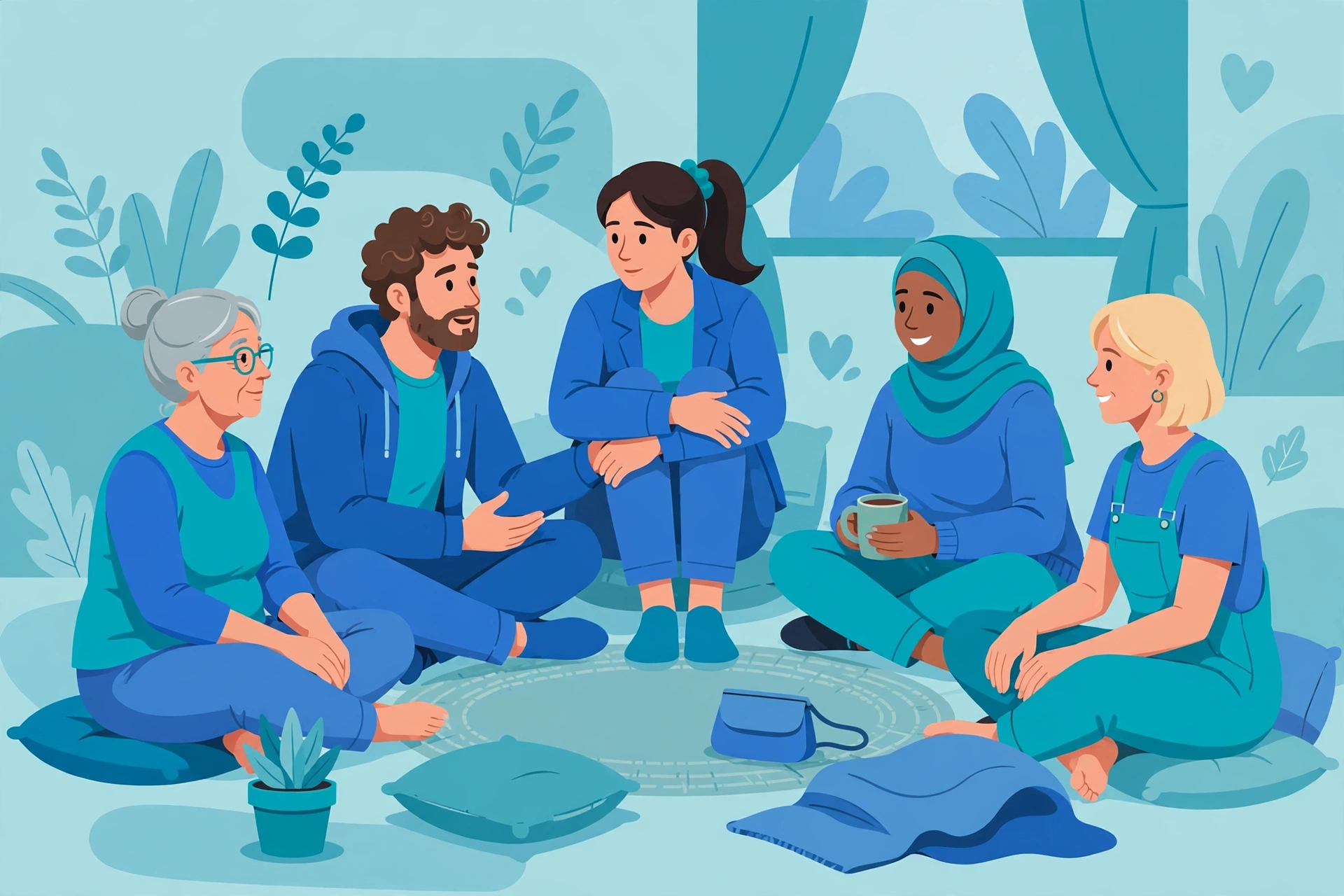
When someone you love lives with mental illness, the whole family lives with it too — the sleepless nights, the worry that never fully switches off, and the guilt that follows you for feeling any of it. Support groups for families of the mentally ill exist because caregivers need care as well. This guide explains what these groups offer, the different kinds available, and how to find one that supports you without judgment.
Key Points
- Family support groups are peer-led spaces for the loved ones of people with mental illness — separate from the groups patients attend.
- They teach practical coping skills, calmer communication, crisis planning, and how to navigate the mental health system.
- The best-known models include NAMI Family Support Groups and the eight-session Family-to-Family education program; hospitals and nonprofits run similar circles worldwide.
- Most groups are free, confidential, and led by family members with lived experience — not by clinicians.
- Attending is not disloyal: caregivers who are supported provide better, more sustainable care.
- In South Asian joint-family systems, these groups also help redistribute a caregiving burden that too often falls on one person, usually a woman.
Why Caregivers Need Their Own Support
Loving someone with a serious mental illness — schizophrenia, bipolar disorder, severe depression, OCD — is one of the most demanding roles a person can hold. Research consistently finds that family caregivers report high rates of stress, anxiety, depression, financial strain, and physical health problems. There is also a quieter wound: ambiguous grief, mourning the person your loved one might have been, alongside love for the person they are.
Guilt compounds everything. Did I cause this? Should I have noticed sooner? Am I doing enough? A family support group is often the first place a caregiver hears the sentence that changes everything: none of this is your fault, and you are not alone in it. In Pakistan and South Asia, where joint families mean the emotional labor of caregiving still concentrates on mothers, wives, and sisters, having a space that is only about your needs can feel unfamiliar. It is also essential — a caregiver running on empty cannot pour indefinitely.
Types of Family Support Groups
Peer-led family support groups
The classic model is a regular, confidential meeting of adult family members and friends of people with mental health conditions. NAMI’s Family Support Group is the best-known example: free, led by trained family peers, usually 60 to 90 minutes, with a structured format so everyone gets heard. The emphasis is on shared experience and mutual encouragement — coping better, releasing guilt, finding strength in humor, and accepting that some problems have no tidy solutions.
Family education programs
Some organizations offer structured courses rather than open-ended meetings. NAMI’s Family-to-Family is a free eight-session program taught by trained family members, covering how mental illnesses work, crisis communication, and how to advocate within the system. Hospital-based psychoeducation programs follow a similar logic.
Condition-specific family groups
Groups focused on one illness — schizophrenia, bipolar disorder, eating disorders, addiction, dementia — let families trade highly specific knowledge: which symptoms signal relapse, which treatments helped, how to handle refusal of medication. When the condition is severe or complex, this specificity matters.
Online forums and virtual meetings
Virtual family meetings and moderated forums remove the barriers of distance, timing, and — importantly — stigma. Many caregivers, especially in conservative communities, find it far easier to speak honestly from behind a screen than to walk into a public meeting. Look for moderated spaces run by established organizations rather than sprawling unmoderated groups.
Faith and community-based circles
Mosques, churches, temples, and community centers sometimes host caregiver circles. These can be deeply comforting when faith is central to your coping — just confirm the group is genuinely supportive rather than moralizing about illness, which helps no one.
What These Groups Actually Give You
Families often arrive expecting sympathy and leave with something far more useful: skills. Regular attendees typically gain calmer communication techniques — how to express concern without criticism, which research links to better outcomes for the ill person. They learn to build crisis plans before the crisis: warning signs, who to call, what has helped before. They trade hard-won knowledge about navigating hospitals, medications, disability benefits, and legal questions like guardianship.
Equally important is what the group takes away: isolation, shame, and the belief that you must handle everything alone. Members learn to set boundaries without guilt and to treat their own health as part of the care plan, not an indulgence. Many caregivers describe the group as the one hour a week when they are the person being cared for.
Where to Find Family Support Groups
Start with the organizations built for this purpose. In the US, NAMI affiliates list Family Support Group meetings (in-person and virtual) by location; similar national alliances exist in the UK, Canada, and Australia. Your loved one’s psychiatrist, hospital social worker, or community mental health center can usually point you to local family programs — ask directly, because these groups are often poorly advertised.
In Pakistan, ask the psychiatry department of the hospital where your loved one is treated — teaching hospitals run family psychoeducation sessions or can refer you onward. Mental health NGOs such as Taskeen and Fountain House work with families of people with severe illness. Online, moderated caregiver forums and private social media groups are active around the clock; choose ones with clear rules and active moderation.
What to Expect — and How to Get the Most From It
A typical meeting opens with introductions and ground rules: confidentiality, no interrupting, no judgment, and no endorsement of specific treatments or clinicians. Members then share — a difficult week, a small victory, a question they can’t ask anywhere else. You may simply listen for your first few meetings; that is normal and welcomed.
To get the most from it, come regularly rather than only in crisis; consistency is what builds trust. Be honest about what isn’t working at home — the group can only help with what it knows. And hold advice lightly: what transformed one family’s situation may not fit yours. One boundary worth holding: the group is for supporting you, not a place to demean your loved one. The best groups gently redirect venting toward problem-solving.
When Your Loved One Refuses Help
One of the most painful situations families bring to these groups is a loved one who refuses treatment — common in conditions like schizophrenia, where insight itself is impaired. A good family group will not offer magic solutions, because there are none. What it offers is steadier ground: strategies for keeping communication open without ultimatums, how to respond to paranoia or grandiosity without escalating conflict, and how to protect the household’s safety and your own limits.
Members learn a difficult but freeing distinction: you cannot control another adult’s choices, but you can influence the environment around them — staying connected, keeping the door open, and being ready when willingness appears. Many families report that their loved one eventually accepted help months after the family first sought support. Your attendance is never wasted, even if theirs hasn’t started.
FAQ
Isn’t it disloyal to talk about my loved one’s illness with strangers?
It feels that way at first, but seeking support is not betrayal — it is maintenance. What is shared in the group stays confidential, and the goal is to make you a calmer, more capable caregiver.
Do I have to share at meetings?
No. Listening is a full form of participation, especially early on. Facilitators in well-run groups explicitly protect newcomers from being put on the spot. Share when — and only when — you are ready.
Are family support groups confidential?
Reputable groups treat confidentiality as a core ground rule: what is said in the meeting stays in the meeting. That said, peer groups are not bound by the same legal privacy rules as clinicians, so avoid sharing highly identifying details until you trust the room.
Can I attend if my ill family member is a child or teenager?
Yes — many groups welcome parents and guardians of minors, and some organizations run groups specifically for parents of children with mental health conditions. Mention your situation when you contact the facilitator so they can confirm the group is a good fit.
Key Takeaways
- Caregiving for mental illness is real work with real costs — your exhaustion, grief, and guilt deserve their own support, not just endurance.
- Family support groups offer peer understanding plus practical tools: communication skills, crisis planning, system navigation, and boundary-setting.
- Choose the format that fits: peer-led meetings, structured education programs, condition-specific groups, or moderated online communities.
- Most groups are free and confidential; listen at first, attend regularly, and take advice as experience to consider, not instructions to follow.
- Getting help for yourself is not disloyal — supported caregivers provide better, longer-lasting care.
- If your loved one refuses treatment, a family group still helps: you learn to keep connection alive and be ready when willingness comes.
