

Every couple fights. The question is never whether you will argue, but whether you can find your way back to each other afterward. If your conversations keep ending in the same painful place — one person shouting, the other shutting down, or both of you sleeping in the same bed feeling miles apart — you may have wondered: what is couples therapy, really? Is it just paying a stranger to watch you argue? This guide explains, in plain language, how couples therapy works, what it can and cannot do, and whether it might be right for you.
Key Points
- Couples therapy is structured counseling where a trained therapist works with both partners together; the relationship itself is the client, not either individual.
- The therapist does not take sides or act as a judge. Their job is to spot the destructive patterns between you and teach you healthier ways to connect.
- The most researched approaches are the Gottman Method, Emotionally Focused Therapy (EFT), and Imago Relationship Therapy — each with strong evidence behind it.
- Couples therapy helps with communication breakdowns, recurring conflict, trust and betrayal, intimacy issues, life transitions, and even deciding whether to stay together.
- Research finds most couples feel better than 70 to 80 percent of those who never get help — but the earlier you go, the easier the work is.
- In South Asia, couples therapy is quietly growing, including online options that make it private, affordable, and accessible beyond the big cities.
What Couples Therapy Actually Is
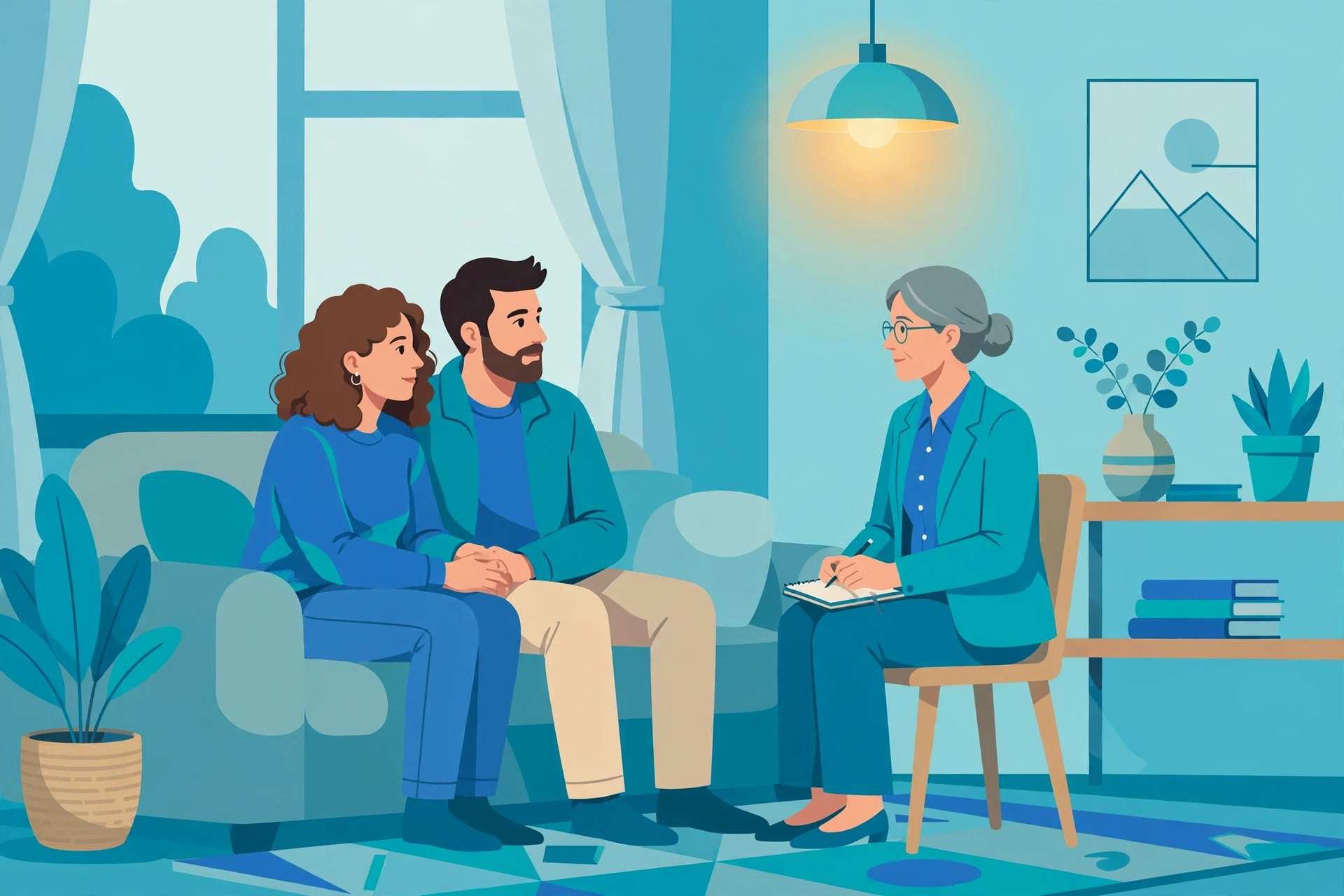
Couples therapy — also called marriage counseling or relationship therapy — is a form of psychotherapy in which a trained therapist works with two partners together to improve the quality of their relationship. That is the textbook definition. In practice, it looks less like lying on a couch and more like a guided conversation: the therapist watches how you two actually interact, names the loop you are stuck in, and helps you practice doing it differently.
One thing that surprises most people: in couples therapy, the relationship is the “client.” A skilled therapist maintains a roughly equal alliance with both partners. They are not there to decide who is right, hand down verdicts, or fix one of you. They are there to change what happens between you.
What it is not
Couples therapy is not a referee service, and a good therapist will never simply tell you to divorce or stay. It is also not only for couples in crisis. Some come after a betrayal or years of fighting; others come because the spark has faded into roommates-with-bills, or because they want strong foundations before marriage. All of these are valid reasons to walk through the door.
How Couples Therapy Works, Step by Step
Most couples therapy follows a similar arc, whatever approach the therapist uses:
1. Assessment: telling your story
The first session or two are about understanding, not fixing. The therapist asks how you met, what was good in the beginning, when things changed, and what a typical argument looks like. Some therapists also meet each partner individually once, to hear the private perspective. Expect questions like: what brings you here now, what have you already tried, and what would feel different if this worked?
2. Naming the pattern
This is where therapy earns its keep. The therapist helps you see that the visible argument — about dishes, in-laws, money — is rarely the real problem. The real problem is the pattern underneath: one partner criticizes, the other withdraws, the first feels abandoned and criticizes louder. Once the pattern is visible, it can be interrupted.
3. Setting shared goals
You agree together on what you are working toward: fighting fairly, rebuilding trust, feeling like a team again. Goals keep therapy practical instead of becoming a weekly complaint session.
4. Learning new skills in the room
Sessions become a practice ground. The therapist will interrupt a familiar spiral mid-motion — that is not rudeness, it is the job — and guide you to try a different response right there, with support.
5. Homework between sessions
Real change happens at home, not in the office. Therapists assign exercises: structured conversations, appreciation lists, planned dates, or simply noticing when the old pattern starts. Couples who do the homework improve far faster.
6. Reviewing progress
Every few sessions you step back and check: are fights shorter, kinder, less frequent? Goals get adjusted as things shift, and therapy ends when you have the tools to keep going on your own.
The Main Approaches, Explained Simply
The Gottman Method
Developed by Drs. John and Julie Gottman from decades of research on thousands of couples, this is the most data-driven approach in the field. It teaches couples to replace the “Four Horsemen” of relationship doom — criticism, contempt, defensiveness, and stonewalling — with their antidotes. Couples build “Love Maps” (deep knowledge of each other’s inner world), learn repair attempts that de-escalate fights, and create rituals of connection and shared meaning. It is practical, structured, and especially good for couples who like concrete tools.
Emotionally Focused Therapy (EFT)
Created by Dr. Sue Johnson and based on attachment theory, EFT sees relationship distress as disconnection: underneath the anger is usually fear — fear of not mattering, of being alone in the relationship. The therapist helps partners identify their negative cycle, then guides them through new, vulnerable conversations where each person can say what they actually need and feel truly heard. EFT has some of the strongest success rates of any approach, with roughly 70 to 75 percent of couples moving from distress to recovery.
Imago Relationship Therapy
Developed by Dr. Harville Hendrix, Imago suggests we unconsciously choose partners who resemble our early caregivers, and that our fiercest conflicts are old childhood wounds in disguise. Its signature tool is the Imago Dialogue: one partner speaks while the other mirrors, validates, and empathizes — no interrupting, no rebuttals. It is slower and more structured, and many couples find it transformative for truly hearing each other for the first time in years.
Other effective approaches
Cognitive-behavioral couples therapy helps partners catch and change the distorted thoughts (“she never listens,” “he doesn’t care”) that fuel fights. Integrative behavioral couples therapy blends acceptance with change. Discernment counseling is a special short-term format for “mixed-agenda” couples where one partner is leaning toward leaving and the other wants to stay.
What Issues Couples Therapy Can Help With
Therapists regularly work with communication breakdowns, the same fight on repeat, emotional distance, loss of intimacy or affection, trust issues and infidelity, disagreements about money, parenting, or in-laws, major transitions (a new baby, job loss, relocation, illness), and premarital preparation. Therapy can also help couples separate with less damage when staying together is not the right choice — a kinder ending is still a worthwhile outcome.
When therapy may not be enough on its own
Be honest with your therapist if there is ongoing physical abuse, active addiction, or a severe untreated mental illness. These usually need specialized treatment first or alongside couples work. A responsible therapist will tell you this plainly rather than take your money for sessions that cannot work yet.
Does Couples Therapy Actually Work?
The short answer is yes — with a caveat. A landmark review in the journal Family Process found that by the end of treatment, most people who participated in couples therapy felt better than 70 to 80 percent of those who received no help. EFT and the Gottman Method both show strong, lasting results in controlled studies.
The caveat is timing. Research from John Gottman’s lab found the average couple waits six years after serious problems begin before seeking help — six years of contempt, defensiveness, and withdrawal becoming entrenched habits. Therapy still works then, but the work is harder. Couples who come earlier, when the pattern is fresh, tend to improve faster and more completely.
The other caveat is effort. Therapy is not something done to you; it is training you practice. The couples who improve most are the ones who show up consistently, do the homework, and risk being vulnerable in the room.
Myths That Keep Couples Away
“Therapy means our marriage has failed”
Seeking help is maintenance, not failure. You service a car before the engine dies; a relationship deserves the same logic.
“The therapist will take my partner’s side”
A trained couples therapist is allied to the relationship, not to either person. If a therapist consistently sides with one partner, that is a bad therapist — find another.
“We will just be told to compromise on everything”
Good therapy is not about splitting every difference. It is about understanding why the differences hurt so much and building a way of handling them that leaves both people intact.
“Only couples about to divorce go”
Many thriving couples use a few sessions as a tune-up: premarital counseling, a check-in after a new baby, or a reset after a stressful year.
A Note for Couples in Pakistan and South Asia
Here, the idea of discussing marital problems with a stranger can feel foreign — even shameful. Many couples first turn to elders, and sometimes that helps. But elders often have a side, and advice like “just be patient” or “think of the children” can keep painful patterns frozen for decades.
Couples therapy is quietly growing in Pakistan’s major cities, and online therapy has changed the equation entirely: sessions from home, in Urdu or English, at lower fees than in-person clinics, with complete privacy from curious relatives. Both partners do not even need to be in the same city. If cost is a barrier, university psychology departments and nonprofit counseling centers in larger cities often offer low-cost sessions with supervised trainees. Needing help with your marriage is not a Western import and not a betrayal of your values — it is two people taking their bond seriously enough to work on it.
Frequently Asked Questions
How long does couples therapy take?
Most couples attend 12 to 20 weekly sessions, though some issues resolve in fewer and deeper ones take longer. EFT typically runs 8 to 20 sessions; Gottman Method work often runs longer. Your therapist should give you a rough roadmap after the assessment phase.
Do both partners have to want to be there?
Ideally yes, but therapy can still help when one partner is reluctant — many skeptics become engaged once they feel genuinely heard. The exception is when one partner has already decided to leave; then discernment counseling (one to three sessions to gain clarity) is the honest format.
Will the therapist tell us to separate?
No ethical therapist makes that decision for you. They will help you see your situation clearly, but the choice to stay or go remains yours.
Can couples therapy help after cheating?
Yes — infidelity is one of the most common reasons couples seek therapy, and many relationships recover and even grow stronger. It requires the unfaithful partner’s full honesty, genuine remorse, and patience, and the hurt partner’s willingness to eventually work toward forgiveness. It is slow work, measured in months, not weeks.
Is online couples therapy effective?
Research says yes — studies find online couples therapy roughly as effective as in-person sessions, especially with structured approaches like EFT and the Gottman Method. It also solves real problems: no travel, easier scheduling, and privacy.
What if we try it and it does not work?
Sometimes the fit is wrong — a different therapist or approach can change everything, so do not judge all therapy by one bad experience. And sometimes therapy’s honest outcome is clarity that the relationship cannot or should not continue. That clarity, painful as it is, is still better than years of stalemate.
Key Takeaways
- Couples therapy treats the relationship as the client, with a neutral therapist helping you see and change destructive patterns.
- The Gottman Method, EFT, and Imago are the most researched approaches — each works, and the best fit depends on your style.
- It helps with communication, recurring conflict, trust, intimacy, transitions, and even parting well.
- About 70 to 80 percent of couples do better than those who never seek help — and earlier is easier than later.
- Myths about failure, side-taking, and “only for the doomed” keep too many couples suffering in silence.
- In Pakistan, online therapy has made couples counseling private, affordable, and available beyond the big cities.