



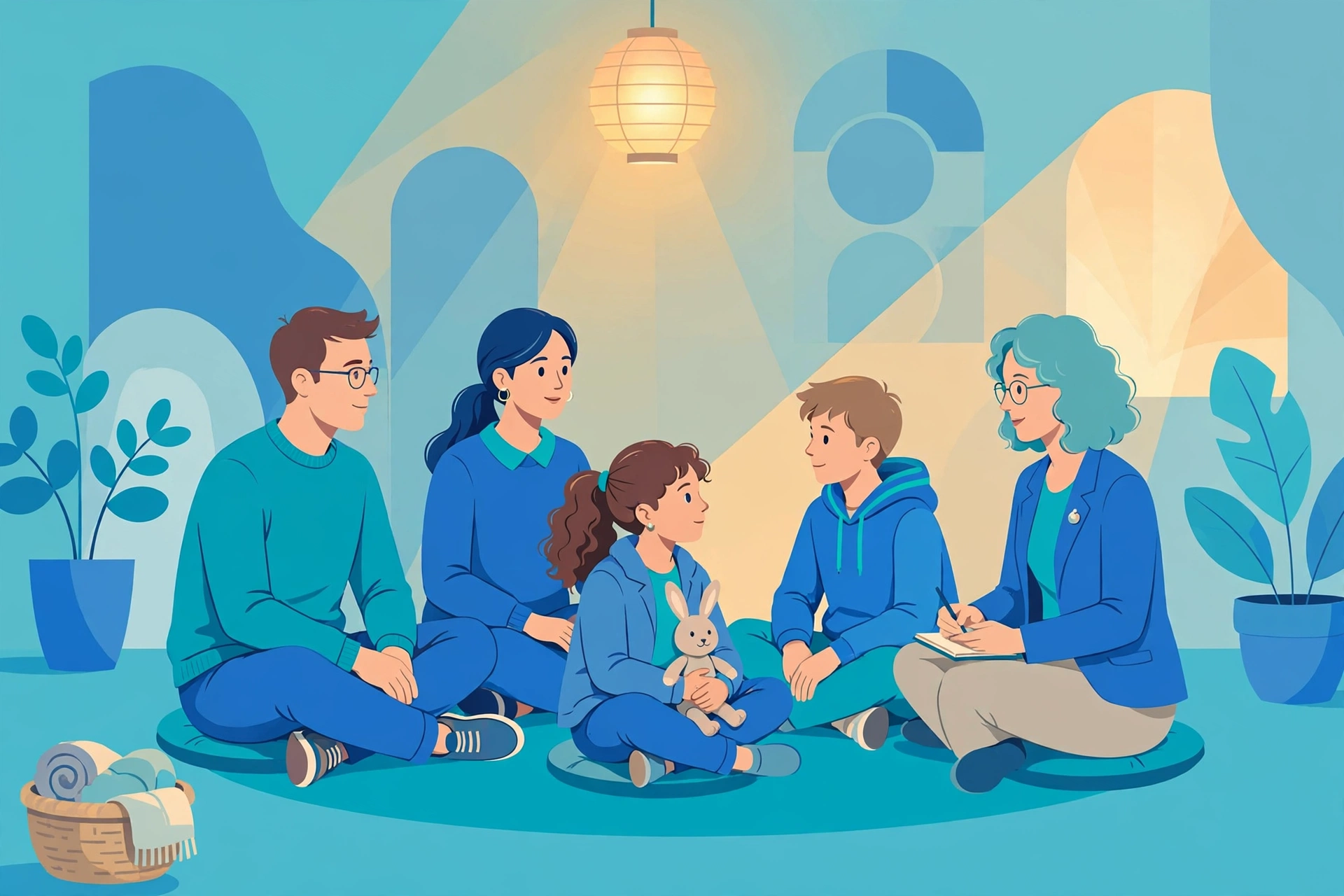
When one person in a family struggles, the whole family feels it — and when one person heals alone, old patterns at home can pull them back. Family therapy starts from this simple truth: problems rarely live inside one person; they live in the space between people. If you have ever wondered what family therapy actually involves, whether it could help your household, or how it differs from one person simply talking to a counselor, this guide explains it all in plain language.
Key Points
- Family therapy is a form of counseling that treats the family as a connected system rather than focusing on one “problem person.”
- It works by improving communication, reshaping unhealthy patterns, and strengthening how family members support one another.
- Main types include structural, strategic, systemic, narrative, solution-focused, and Bowenian family therapy — each suited to different situations.
- Common techniques include genograms, circular questioning, reframing, role-playing, and family sculpting.
- It helps with conflict, parenting struggles, mental illness, addiction, grief, divorce, and life transitions.
- In Pakistani and South Asian joint families, it can be adapted to respect elders’ roles while giving every member a voice.
What Is Family Therapy, Really?
Family therapy is a branch of psychotherapy in which a trained therapist works with some or all members of a family together. Instead of treating an individual’s anxiety, depression, or behavior in isolation, the therapist looks at the whole picture: how members communicate, who holds power, which alliances and conflicts keep repeating, and how the family’s “rules” — spoken and unspoken — shape everyone’s behavior.
The central idea comes from systems theory: a family is like a mobile hanging over a crib — touch one piece and every other piece moves. When a teenager acts out or a marriage strains, the family adjusts around it, sometimes in ways that accidentally keep the problem alive. A family therapist helps everyone see these loops and change them together.
This is also why therapists talk about the “identified patient” — the one person everyone points to as the problem. In family therapy, that person is treated as the family’s messenger, carrying a difficulty that belongs to the whole system. Nobody is blamed; the pattern is the patient.
How Family Therapy Works
Family therapy is practical and present-focused. Rather than spending months analyzing childhoods, most sessions deal with what is happening at home right now: who talks to whom, how decisions get made, and where communication breaks down. It is often shorter than people expect — many approaches run 8 to 20 sessions, with progress reviewed regularly against agreed goals.
Who attends
Sessions usually include the people most involved in the problem — parents and children, a couple, or an extended group. In South Asian contexts, this may include grandparents or in-laws, since they are genuinely part of the household system. The therapist sometimes meets subgroups separately to hear perspectives people cannot voice in front of everyone.
The Main Types of Family Therapy
There is no single “family therapy” — there are several well-developed schools, and a good therapist often blends them. Here are the main ones, in plain terms.
Structural family therapy
Developed by Salvador Minuchin, this approach maps the family’s structure: who is in charge, where the boundaries are, and which subgroups have become blurred or rigid. Common problems include “enmeshment” (everyone overly involved in everyone else’s business) and “disengagement” (members emotionally distant). The therapist actively rearranges interactions in the session — who speaks first, who decides — to build healthier hierarchies and clearer boundaries.
Strategic family therapy
Strategic therapists are problem-solvers. They pinpoint the interaction loop keeping a problem alive and assign targeted tasks to break it — for instance, prescribing an unexpected parental response that disrupts the payoff of a child’s tantrums. It is direct, short-term, and focused on one problem at a time.
Systemic (Milan) family therapy
This school treats the family’s beliefs and meanings as the real issue. Through circular questioning — asking each member how they see the others’ interactions — the therapist helps everyone view the problem through fresh eyes. The goal is to shift how the whole family understands what is happening, not just fix one behavior.
Narrative family therapy
Narrative therapists believe families get trapped by the stories they tell about themselves — “we are the family with the difficult son.” The therapist helps the family “externalize” the problem (the problem is the problem, the person is not the problem) and build a new story from times they coped well. It is especially powerful where shame or blame runs deep.
Solution-focused brief therapy
Instead of dissecting the problem, this approach asks when the problem is not happening and what is different then. The “miracle question” — “If you woke up tomorrow and the problem was solved, what would be different?” — helps families describe the future they want and take small steps toward it. Brief, optimistic, and practical.
Bowenian and other evidence-based models
Murray Bowen’s approach focuses on differentiation: staying connected to family without being swallowed by its emotions. It maps multigenerational patterns — anxiety and conflict styles repeating across generations — often using a genogram, a detailed family map. One member working on their own differentiation can calm the entire system. Related models with strong research behind them include Functional Family Therapy (FFT) for adolescent behavior problems, Multisystemic Therapy (MST) for serious youth conduct issues, and Emotionally Focused Therapy (EFT), which rebuilds secure emotional bonds, particularly between couples.
Key Techniques You’ll Encounter
Whatever the school, family therapists draw on a shared toolkit. Knowing these in advance makes the first session less mysterious.
Genograms
A genogram is a visual family tree that maps relationships, conflicts, cutoffs, and repeating patterns across three or more generations. Many families are startled to see their current struggle echoing a grandparent’s story.
Circular questioning
Instead of asking “why do you fight?”, the therapist asks each person how they see others’ interactions. Hearing your brother describe your marriage from the outside can be more revealing than any direct question.
Reframing
The therapist offers a more generous interpretation of a behavior: a “controlling” mother becomes a frightened mother trying to prevent another loss. Reframing does not excuse behavior — it makes change feel possible.
Enactments and family sculpting
Rather than just talking about a conflict, the family has the conversation right there in the room while the therapist coaches in real time. In sculpting, members physically position each other to show how the family “feels” — who is close, who is distant, who carries the weight.
Homework and rituals
Change happens between sessions. Therapists assign small, specific tasks: a weekly family meeting, a new bedtime routine, a rule that complaints must come with a proposed solution. Small consistent experiments beat grand resolutions.
What Issues Can Family Therapy Help With?
Family therapy is not only for families in crisis. It helps with:
- Persistent conflict — shouting matches, silent treatments, or cold wars between members
- Parenting disagreements and struggles with children’s behavior or school problems
- A family member’s mental illness, addiction, or chronic disease, and the strain it puts on everyone
- Grief, trauma, or a major crisis the family went through together
- Divorce, separation, remarriage, and blending families
- Life transitions: a new baby, teenagers leaving home, aging parents needing care
- In-law and extended-family tensions, especially in joint households
It is worth saying plainly: you do not need a “serious” problem to benefit. Many families use a few sessions as a tune-up — to improve communication before small cracks widen.
What a Typical Session Looks Like
The first session is mostly assessment. The therapist asks each person what brings them in and what they hope will change, and everyone gets heard — including children, in age-appropriate ways. Together you agree on concrete goals, like “we will resolve disagreements without shouting” rather than vague wishes like “be happier.”
Later sessions follow the goals. The therapist might map your family structure, teach a communication skill and have you practice it on the spot, or unpack a recent blowup moment by moment. Sessions usually last 60 to 90 minutes. Expect to feel uncomfortable at times — honest conversation often is — but you should never feel attacked or judged. If you do, say so; a good therapist will adjust immediately.
Does Family Therapy Actually Work?
Yes — it is among the better-researched forms of counseling. Decades of studies show family therapy improves communication, reduces conflict, and helps with a wide range of problems from adolescent behavior issues to adult depression and substance use. When families participate in addiction treatment, for example, engagement rates climb dramatically compared to treating the individual alone. Models like FFT and MST have particularly strong evidence for youth behavioral problems, with effects that last well beyond the final session.
That said, therapy is not magic. It works best when members attend consistently, practice new patterns between sessions, and are honest in the room. If one key person refuses to come, all is not lost — change in one member still shifts the whole system.
Family Therapy in Pakistan and South Asia
Here, family therapy meets a distinctive landscape — and some of its greatest opportunities.
The joint family advantage
Western therapy models were built for nuclear families, but South Asia’s joint households are, in a sense, already “systemic” — grandparents, uncles, aunts, and in-laws genuinely shape daily life, so a therapist who includes them is simply being accurate. The challenge is hierarchy: elders expect deference, and younger members — especially daughters-in-law — may never have been asked what they think. A skilled therapist honors elders’ status while making room for quieter voices, and progress often comes faster here, because when the system shifts, it shifts for many people at once.
Stigma and how to handle it
Admitting “our family needs therapy” can feel like announcing failure in communities where family honor is paramount. Reframing helps: this is a strong family investing in itself — no different from hiring a tutor when a child struggles. Therapy is confidential, and many families choose online sessions precisely for privacy.
Cost and access
Private family therapy in major cities typically costs a few thousand rupees per session — significant, but often less than the price of months of unresolved conflict. Lower-cost options exist: university psychology departments run supervised clinics, NGOs offer subsidized counseling, online platforms reach smaller cities, and some therapists offer sliding-scale fees if you ask.
Frequently Asked Questions
Is family therapy only for families with serious problems?
No. While it is highly effective for serious issues like addiction or chronic conflict, many families attend for everyday goals: better communication, smoother parenting, or adjusting to a new life stage. Think of it as maintenance, not just repair.
Will the therapist take sides or blame someone?
A trained family therapist does not take sides or assign blame. If you feel ganged up on, raise it in the session — and if the pattern continues, find another therapist. Feeling safe with the therapist is non-negotiable.
What if a family member refuses to attend?
Start without them. Change in one part of the system moves the whole, and reluctant members often join once they see others changing. The therapist can also help you understand what the refusal itself is communicating.
How is family therapy different from couples therapy?
Couples therapy focuses on the partnership between two people. Family therapy involves the wider system — parents and children, siblings, sometimes extended family. Many therapists do both, and the two often overlap.
Can family therapy be done online?
Yes, and it works well for many families. Video sessions remove travel and scheduling barriers, which matters when coordinating several busy people. For very young children or high-conflict situations, in-person sessions may still be preferable.
How do I know if it is working?
Look for concrete changes: fewer and shorter arguments, calmer recoveries after disagreements, a child opening up more, or a lighter atmosphere at home. Your therapist should review progress against your original goals every few sessions — ask directly if they do not.
Key Takeaways
- Family therapy treats relationship patterns, not just individuals — the system is the client.
- Structural, strategic, systemic, narrative, solution-focused, and Bowenian approaches each offer different paths to the same goal: a healthier family.
- Techniques like genograms, circular questioning, reframing, and in-session practice make abstract ideas concrete.
- It helps with conflict, parenting, mental illness, addiction, grief, divorce, and transitions — and works as prevention too.
- Research supports its effectiveness, especially when the family participates actively.
- In South Asia, it adapts well to joint families — honoring elders while giving every member a voice.
