



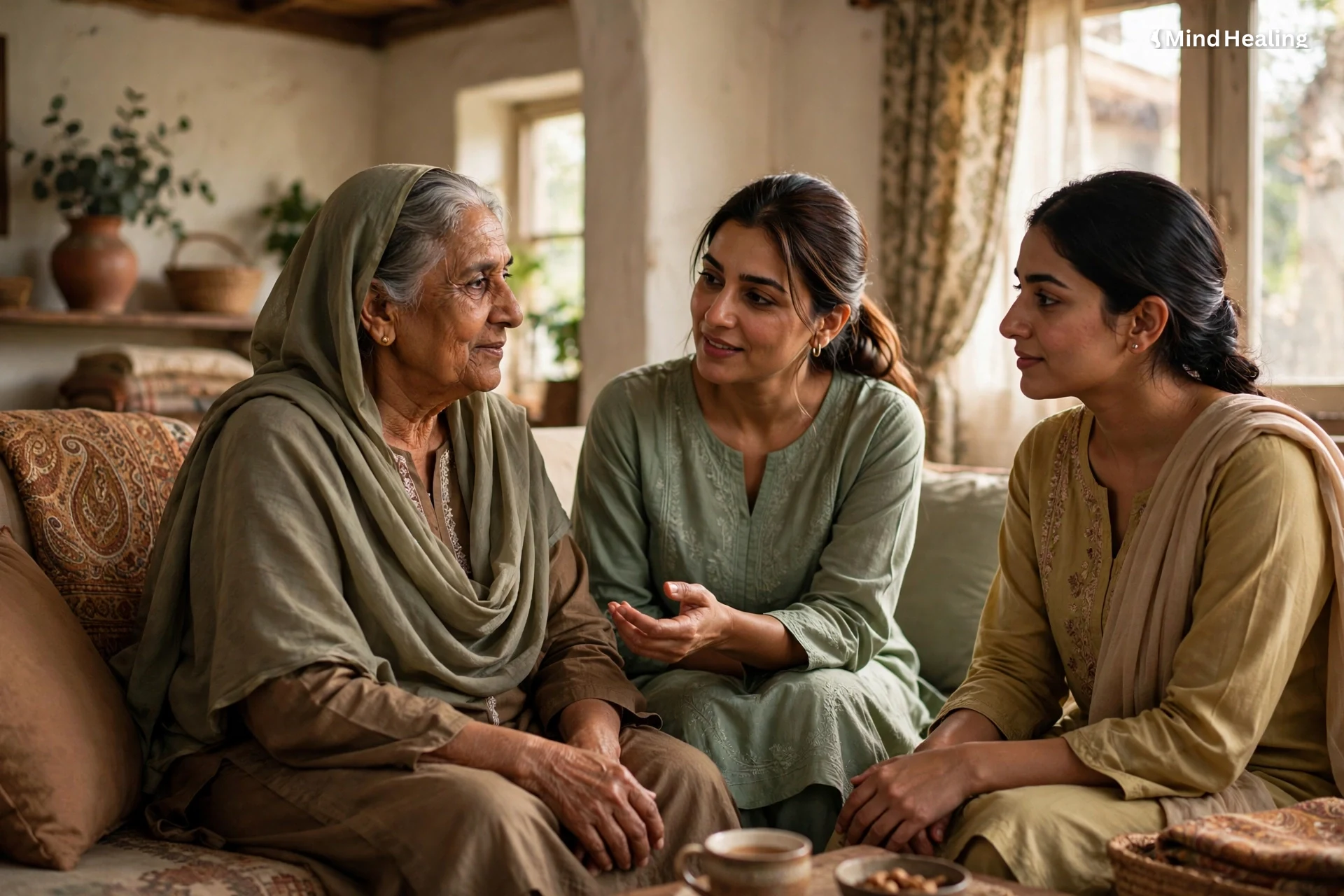
In Pakistan, a young man begins hearing voices. He grows suspicious, stops sleeping, accuses his family of poisoning him. What happens next depends less on medicine than on meaning: does his family see a dimaghi bimari — a brain illness needing a doctor — or a case of possession, black magic, or madness to be hidden? For too many Pakistani families, the answer is the second, and the consequences are measured in years of untreated psychosis, chained bodies at shrines, shattered marriage prospects, and mothers who suffer in silence because speaking the truth would brand the whole family.
This guide confronts the Pakistani reality of schizophrenia honestly: the depth of the stigma, the spiritual frameworks that delay care, the severe shortage of psychiatrists, and — crucially — the care that does exist and how families can reach it. It is written for Pakistani families, and for anyone who wants to understand why treating schizophrenia here requires fighting culture as well as chemistry. For the medical foundations, see our guides to what schizophrenia is and how treatment works; for the day-to-day of caregiving, our family guide.
Key Points
- Stigma in Pakistan goes far beyond embarrassment: the label “pagal” dehumanizes the person and taints the entire family’s honor, marriage prospects, and social standing — driving years of secrecy and delayed treatment.
- Psychotic symptoms are widely attributed to jinn possession, nazar (evil eye), or kala jadu (black magic), channeling families toward shrines and faith healers first — where chaining, confinement, and abuse still occur — and psychiatrists last.
- Pakistan faces a severe treatment gap: roughly one psychiatrist per 500,000+ people, concentrated in major cities, with mental health receiving a tiny fraction of the health budget.
- Effective care is available: psychiatry departments in teaching hospitals, private psychiatrists (increasingly via telepsychiatry), and institutions like Fountain House Lahore — and essential medications are affordable as generics.
- Families are the care system in Pakistan — educating the whole household, designating a treatment anchor, and maintaining follow-up are the highest-impact actions available.
- Change is possible: religious scholars, teachers, and community elders who learn the medical facts become powerful allies against stigma.
The Weight of a Single Word: “Pagal”
Language shapes reality, and in Pakistan one word does enormous damage: “pagal.” Applied to a person with schizophrenia, it doesn’t describe an illness — it erases a person. A “pagal” is not someone with a condition; in common usage, they are the madness: unpredictable, lesser, laughable or fearsome, someone to be hidden, chained, or pitied. The word follows them into every domain of life — no employer hires a “pagal,” no family marries into a “pagal’s” household, no neighborhood fully accepts one.
Worse, the taint spreads. In a culture where family honor (izzat) is collective, one member’s psychosis becomes the whole family’s shame. Parents hide the illness not from cruelty but from love — love for their other children, whose marriage prospects they believe are at stake; love for the ill child, whom they want to protect from mockery. Sisters are told to keep quiet “or no one will marry you.” The result is a conspiracy of silence that typically delays psychiatric treatment by years — and research is unambiguous that longer untreated psychosis means worse long-term outcomes: more entrenched symptoms, greater functional loss, harder recovery. Stigma here is not just a social problem; it is a medical one, measured in damaged brains and lost lives.
The gendered edge of stigma
Stigma cuts differently by gender. A young man with schizophrenia may be tolerated as “eccentric” longer, but faces pressure as a failed provider. A young woman faces something harsher: her illness is read as making her unmarriageable, and unmarried daughters carry their own stigma — a double bind with no exit. Wives who develop schizophrenia after marriage are disproportionately divorced or sent back to their parents; husbands who develop it are more often kept and cared for. Women with psychosis are also more vulnerable to abuse and exploitation, including within care settings. Any honest discussion of schizophrenia in Pakistan must name this asymmetry — and families must consciously resist it.
Spirits, Shrines, and Lost Years
When a Pakistani family first encounters psychosis — voices no one else hears, wild accusations, bizarre behavior — the available cultural explanations are spiritual: possession by jinn, the evil eye (nazar), black magic (kala jadu) cast by a jealous relative or rival. These frameworks are coherent, ancient, and socially validated; the local pir (faith healer) confirms the diagnosis the family already suspects. So begins the typical journey: months or years moving between healers and shrines, spending sums the family can ill afford, while the psychosis — a progressive brain process — deepens untreated.
What happens at shrines
Some shrines (dargahs) are places of genuine comfort and community. But a documented minority practice involves the chaining, caging, or confinement of people believed to be possessed — sometimes for months — along with beatings to “drive out” spirits, food deprivation, and forced ingestion of unknown substances. Human rights organizations and journalists have documented these abuses repeatedly; they persist because they happen out of sight, to people whose testimony is discounted as madness, in the name of religion. Let us be unequivocal: chaining a person with schizophrenia is torture, not treatment, and it has no basis in Islam or any faith’s true teachings. Voices respond to antipsychotic medication. They do not respond to chains.
Faith and medicine are not enemies
The way forward is not to attack faith — that alienates the very families we need to reach — but to separate spiritual comfort from medical treatment. Prayer, Quranic recitation, the support of a compassionate religious community: these genuinely help many patients and families endure, find meaning, and stay hopeful — and they are fully compatible with psychiatric care. Increasingly, Pakistani psychiatrists and thoughtful religious scholars say the same thing: Islam commands seeking treatment for illness (tadawi), and the Prophet’s tradition honors medicine. The message that works: take the medicine and make the dua. Families don’t have to choose between their faith and their child’s brain — and presenting it as a choice is what drives people away from care.
The Treatment Gap: Numbers That Shame
Pakistan’s mental health infrastructure is among the thinnest in the region. The commonly cited figure — roughly one psychiatrist for every 500,000 to over a million people (against roughly 500+ needed per WHO benchmarks for the population) — understates the problem, because psychiatrists cluster in Karachi, Lahore, Islamabad/Rawalpindi, and a few other cities. For a family in rural Sindh, Balochistan, or southern Punjab, the nearest psychiatrist may be a day’s journey away — an impossible trip to repeat monthly for follow-up.
Mental health receives a tiny fraction of Pakistan’s health budget (well under 1% in most estimates), there are few dedicated psychiatric beds outside major teaching hospitals, community mental health services barely exist, and mental health legislation — the provincial Mental Health Acts that replaced the 2001 Ordinance after devolution — is weakly implemented in most provinces. Health insurance rarely covers psychiatric care, and out-of-pocket costs fall on families already strained by the illness’s economic toll: lost income from the patient, lost income from the caregiving family member, and years of spending on healers before medicine is ever tried.
The family as the care system
In the absence of community services, the Pakistani joint family is the mental health system — for better and worse. Better: patients are rarely abandoned to the streets; there are eyes to notice relapse, hands for hospital visits, and a cultural ethic of caring for ill kin. Worse: care quality depends entirely on the family’s knowledge and resources; the burden falls overwhelmingly on women (mothers, wives, sisters); and family “care” without medical guidance can mean confinement, forced treatments, or endless healer circuits. Strengthening the family — through psychoeducation, not blame — is therefore the single highest-leverage intervention available in Pakistan. Our family guide is written for exactly this reality.
Where to Find Care: A Practical Map
Care exists. Finding it is the challenge — so here is the map, as concretely as possible:
Teaching hospital psychiatry departments
The most reliable entry point for most families: psychiatry departments at major public teaching hospitals (in Lahore, Karachi, Islamabad, Peshawar, Multan, Faisalabad, Hyderabad, Quetta, and others) offer evaluation, affordable medication, and follow-up at minimal cost. Waiting times can be long and privacy limited, but the clinical quality is real — these departments train the country’s psychiatrists. For a first episode or a crisis, this is where to go.
Private psychiatrists and telepsychiatry
Private psychiatric practice has grown substantially in major cities, offering shorter waits and more privacy at higher cost (consultation fees vary widely; ask upfront). Since the pandemic, telepsychiatry — video consultations — has expanded dramatically, letting families in smaller cities access urban psychiatrists for follow-up without repeated travel. Verify credentials (PMDC/PMC registration, recognized qualifications like FCPS Psychiatry); be wary of anyone promising cures, demanding large advance payments, or discouraging standard medication.
Fountain House and rehabilitation
Fountain House in Lahore — operating since the 1970s — remains Pakistan’s best-known institution for the rehabilitation of people with serious mental illness, offering day programs, vocational training, and residential care. Similar smaller initiatives exist in other cities. For long-term recovery — rebuilding work skills, daily structure, and social life — rehabilitation matters as much as medication, and families should ask psychiatrists for local referrals.
NGOs and helplines
Several Pakistani NGOs work in mental health awareness and services (the landscape shifts, so verify current operations): organizations offering counseling helplines, community programs, and advocacy. University psychology departments in major cities often run low-cost clinics staffed by supervised trainees — an underused resource for therapy and assessment. For general mental health guidance, our health disorders hub and therapies overview can orient families.
Making treatment affordable
Cost stops many families — but less than they fear. Many effective antipsychotics are available as inexpensive generics in Pakistani pharmacies; first-generation drugs and older second-generation agents (which work well for many patients) cost a fraction of newer brands. Ask the psychiatrist explicitly for effective low-cost options rather than assuming the newest drug is needed. What should never be economized is follow-up itself: the consultation that prevents a relapse costing tens of thousands in crisis care is the cheapest medicine there is. And avoid the false economy of healers — the average family spends more on shrines and pirs before seeing a psychiatrist than a year of proper treatment would cost.
What Pakistani Families Should Do: Step by Step
If someone in your family is showing signs of psychosis — hearing voices, holding unshakeable false beliefs, withdrawing, deteriorating — here is a concrete path:
- Step 1: Name it medically, not spiritually. Learn the symptoms (see our schizophrenia overview). The earlier the family accepts a medical frame, the sooner treatment begins.
- Step 2: Get a psychiatric evaluation promptly. Go to the nearest teaching hospital psychiatry department or a qualified private psychiatrist. Bring a written timeline of changes you’ve observed — clinicians value structured family history enormously.
- Step 3: Start treatment and commit to follow-up. Take medication exactly as prescribed, attend every follow-up, and report side effects rather than quietly stopping. Ask about long-acting injectables if daily pills are a struggle.
- Step 4: Educate the whole household. One meeting where the doctor (or trusted literature) explains the illness to elders, uncles, and aunts prevents years of sabotage-by-advice. Everyone should hear: it is a brain illness, medicine treats it, criticism and stress worsen it.
- Step 5: Protect the primary caregiver. Divide tasks explicitly — pharmacy, appointments, costs, daily supervision — so one mother or wife doesn’t collapse under it all.
- Step 6: Plan for the long term. Schizophrenia is managed, not cured in a month. Build the relapse-prevention plan, keep the psychiatrist’s number saved, and treat follow-up like any chronic illness — the way you’d manage diabetes.
- Step 7: Do not marry them off as a “cure.” Marriage does not treat psychosis; it adds stress that commonly triggers relapse and harms an unsuspecting spouse. Stability first, honesty always.
In an emergency
If the person is in danger of harming themselves or others, cannot eat, drink, or care for basic needs, or has become completely unreachable — treat it as a medical emergency and go to the nearest hospital immediately. Do not wait for a “convenient” time, do not try to manage it with family restraint alone, and do not take them to a shrine or healer in crisis. Emergency departments at major public hospitals can stabilize acute psychosis; the psychiatrist can then arrange ongoing care.
Rights and Dignity: What the Law Says
People with schizophrenia have the same human rights as anyone else — including the right to humane treatment, which chaining and confinement violate. Pakistan’s mental health legislation (provincial Mental Health Acts, succeeding the Mental Health Ordinance 2001 after the 18th Amendment devolution) provides frameworks for voluntary and involuntary admission and for the protection of patients’ rights — though implementation remains weak and most families never encounter these laws in practice. What families should know:
- Involuntary treatment is permitted in genuine emergencies — when a person is a danger to themselves or others or cannot care for themselves — through proper medical and legal channels, not through family improvisation.
- Chaining, beating, or confining a person with mental illness is abuse — reportable and punishable, regardless of who does it or in whose name.
- Discrimination has no legal or moral standing: an employer or institution rejecting someone solely for a treated mental illness is practicing the prejudice, not prudence.
- Keep medical records organized — prescriptions, discharge summaries, test reports — in one file. In a system with thin continuity, the family’s file is the medical record.
Changing the Story: From Shame to Action
Stigma in Pakistan will not fall because of one article — but it falls every time a trusted voice speaks plainly. Religious scholars who teach that seeking medical treatment is a religious duty. Teachers who notice a withdrawing student and suggest a doctor instead of a taweez. Elders who tell the extended family “this is an illness, we treat it like any illness.” Recovered patients and families who speak openly — the single most powerful anti-stigma force known to research is contact with real people living in recovery.
Media has a role too: Pakistani dramas and news reach every household, and responsible portrayals of mental illness — as treatable medical conditions affecting dignified human beings — reshape public understanding faster than any pamphlet. And each family that chooses the psychiatrist over the shrine, that keeps the follow-up appointment, that refuses to chain and insists on treating — each one is a quiet revolution. The goal is not to import a foreign model but to build a Pakistani one: medical treatment at the center, family strength harnessed, faith as comfort rather than substitute, and dignity non-negotiable.
Frequently Asked Questions
How many psychiatrists are there in Pakistan?
Estimates vary, but Pakistan has only a few hundred psychiatrists for over 240 million people — roughly one per 500,000 to over a million, far below international recommendations. They are concentrated in major cities. Telepsychiatry is increasingly bridging the gap for follow-up care in underserved areas.
Can a pir or shrine cure schizophrenia?
No. Schizophrenia is a brain disorder that responds to antipsychotic medication and psychosocial treatment — not to exorcism, amulets, or shrine rituals. Some families find spiritual practices comforting alongside medical care, and that is their right; but substituting spiritual treatment for medical care wastes critical time and sometimes subjects the person to abuse. Take the medicine and make the dua.
How much does schizophrenia treatment cost in Pakistan?
Less than most families fear: evaluation at a public teaching hospital is minimal-cost, and many effective antipsychotics are available as inexpensive generics. Private consultations cost more but are manageable for many middle-class families. The most expensive option is actually not treating it — relapses, crises, lost income, and years of spending on healers cost far more than consistent medical care.
Should we hide the diagnosis from relatives and neighbors?
Many families do, out of realistic fear of stigma — and that choice deserves respect, not judgment. But total secrecy has costs: it delays help-seeking, isolates the caregiver, and teaches the patient shame. A middle path works best: be selective and strategic — tell those whose support you need, keep it private from those who would only gossip, and let the patient (when stable) guide disclosure about their own life.
Can a person with schizophrenia marry and have children?
Medically, yes — many people with well-managed schizophrenia marry and parent successfully. But marrying someone off as a cure, or arranging a marriage without informing the other party of the illness, is unethical and usually disastrous. Any marriage should wait for stability, involve full honesty with the prospective spouse and their family, and include a plan for ongoing treatment and support.
What should I do if a relative has been chained at a shrine?
Act urgently: the person needs medical evaluation, not continued confinement. Involve the immediate family in choosing psychiatric care, contact local authorities or human rights organizations if the shrine resists release, and document what happened. Chaining is abuse — compassion for the family’s desperation should not extend to tolerating torture.
Key Takeaways
- In Pakistan, schizophrenia’s heaviest burden is stigma: the “pagal” label, family shame, and spiritual misattribution delay treatment by years — and delay measurably worsens outcomes.
- Chaining and shrine-based confinement are abuse, not treatment; faith comforts best alongside medicine, never instead of it.
- The treatment gap is severe (psychiatrists clustered in big cities, tiny budgets), but real care exists: teaching hospitals, private and telepsychiatry, Fountain House, and affordable generic medications.
- The family is Pakistan’s mental health system — educate the whole household, share the load, keep every follow-up, and never marry the illness away.
- In an emergency — danger to self or others, inability to meet basic needs — go to the nearest hospital immediately.
- Change starts with plain speech: learn the medical facts in our schizophrenia overview, treatment guide, and myths vs. facts — then share them with one elder, one teacher, one neighbor.
