



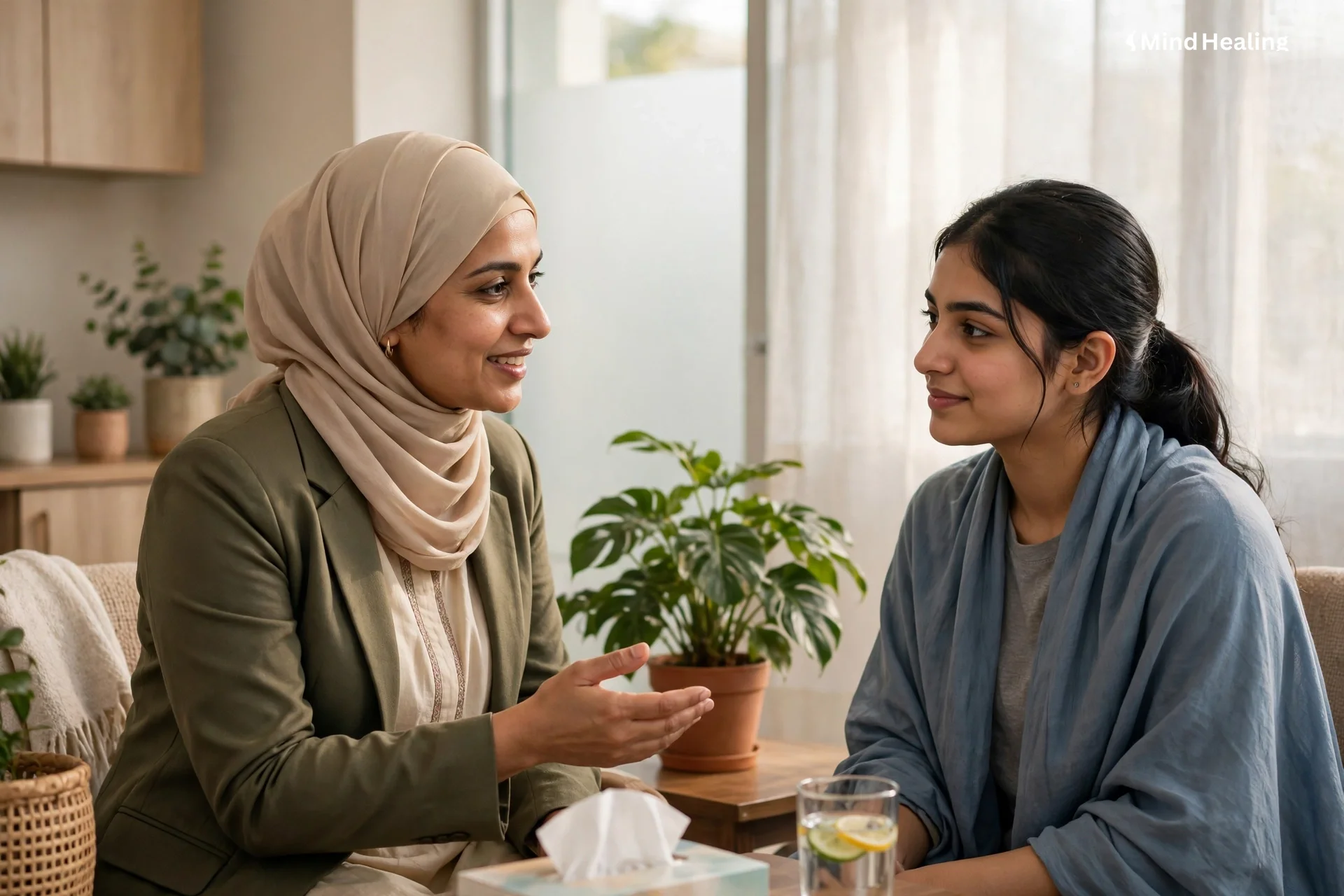
Millions of people in Pakistan live with depression — students crushed by exam pressure, mothers exhausted and unsupported, men buckling under the weight of providing, young people grieving in silence. Yet depression is rarely named out loud. It is called “udasi” (sadness), “dil ghabrana” (a restless heart), “tension,” or simply “weakness.” Because it goes unnamed, it often goes untreated — sometimes until it becomes a crisis.
Depression in Pakistan is not a Western import or a rich person’s problem. It is a real, common, and treatable health condition touching every class, city, and age group. What makes it so painful here is not just the illness itself, but the silence around it: the stigma, the shame, and the very real barriers to getting help. This article looks honestly at all of it — and then shows that help exists, that recovery is possible, and that change has already begun.
Key Points
- Depression is common in Pakistan but rarely named — people describe it as “udasi,” “tension,” or physical complaints.
- Stigma labels like “pagal” (mad), family honor (izzat) concerns, and gendered expectations keep many from seeking help.
- Structural barriers include too few professionals, urban concentration of services, cost, and long travel distances.
- No everyday Urdu word for depression exists — building that vocabulary is a key long-term task.
- Faith and family, handled with wisdom, can become powerful allies in recovery rather than obstacles.
- Help is available: university clinics, NGOs, private practitioners, online therapy in Urdu, helplines, and your family doctor.
How Common Is Depression, and How Rarely It Is Named
Global health research consistently ranks depression among the leading causes of disability worldwide, and Pakistan is no exception. Studies suggest a significant share of the population experiences depression or anxiety at some point — yet the number actually diagnosed and treated is a tiny fraction of that.
The gap between suffering and naming has several causes. Many Pakistanis never learned a word for depression as a medical condition. Urdu has a rich vocabulary for emotional states — udasi, gham, dil ghabrana, bechaini — but no everyday term carrying the meaning of clinical depression. So people describe what they feel in emotional or physical language: “mera dil ghabrata hai” (my heart feels uneasy), “neend nahi aati” (I can’t sleep), “sir mein dard rehta hai” (I always have a headache). These are real expressions of depression — but because neither the patient nor often the doctor names the illness, it goes untreated. To understand what depression actually is beyond these everyday words, read Understanding Depression: Symptoms and Causes.
Depression across Pakistani life
Depression does not discriminate. It affects the CSS aspirant studying sixteen hours a day, the housewife whose work is never acknowledged, the laborer whose wages no longer feed his family, the student far from home, the young woman pressured into a marriage she fears, the man who lost his job and cannot tell his father. When life is hard for everyone, individual suffering becomes invisible — but a hard life does not make depression any less real or any less treatable.
Stigma: The Heaviest Barrier
Of all obstacles to mental health care in Pakistan, stigma is the most powerful. It operates in the words people use, in family decisions, in how suffering is explained, and in different rules for women and men.
The “pagal” label
The single word “pagal” (mad/crazy) does enormous damage. Mental illness is widely conflated with severe psychosis — the image of someone wandering the streets. Depression, a common and treatable condition, gets swept into the same category. Families fear that if a daughter sees a psychiatrist, “no one will marry her,” or that a son admitting depression will be seen as weak. So the illness is hidden, the person suffers alone, and the family guards a secret that slowly harms everyone inside it.
Family honor and izzat
Where family honor (izzat) is central, a mental health diagnosis can feel like a stain on the whole family. Relatives urge secrecy: “Don’t tell anyone, what will people say?” (log kya kahenge). Say it plainly: a family that helps its member recover earns more honor than one that hides their pain. Real izzat is in caring for your own.
Spiritual framings of suffering
Many Pakistanis understand suffering spiritually — as a test from Allah, weak faith, the evil eye (nazar), or jinn. Faith itself is not the problem; prayer, community, and trust in Allah sustain countless people through their darkest times. The problem arises when depression is framed as a spiritual failing: “If your iman were stronger, you wouldn’t feel this way.” That turns a medical condition into a moral verdict. The scholars and imams who understand that illness and faith coexist are among mental health’s most powerful allies.
Gendered barriers: different cages for women and men
Women face particular obstacles: limited mobility to visit clinics alone, financial dependence, the expectation to endure suffering silently as a “good” wife or daughter, and dismissal of their distress as “hormones” or “drama.” Postpartum depression goes almost entirely unrecognized — a new mother’s suffering buried under celebration and expectation. See Postpartum Depression Guide.
Men face the mirror-image trap: the demand to be strong, “mard ban” pressure, the provider identity that makes emotional struggle feel like failure. Read more in Depression in Men: Hidden Signs and How to Help.
Structural Barriers: It’s Not Just Attitude
Even when someone overcomes stigma and decides to seek help, the system itself stands in the way. These are real, practical barriers.
Too few professionals
Pakistan has far too few psychiatrists and psychologists for over 240 million people — estimates suggest fewer than one psychiatrist per several hundred thousand people. The result: long waits, rushed appointments, and for many, no access at all.
Urban concentration
Nearly all services cluster in major cities — Karachi, Lahore, Islamabad, and a handful of others. For someone in a small town or village, the nearest psychiatrist may be hours away. For women with limited mobility, that distance alone can make care impossible.
Cost
A single private therapy session can cost several thousand rupees — impossible for a family living hand to mouth. Public hospitals offer cheaper care, but psychiatric departments are overstretched, and crowded wards with little privacy discourage many from returning.
The language gap
There is no everyday Urdu word for depression — and this is not a small detail. Without shared language, people cannot describe their condition, doctors misinterpret physical complaints, and families cannot discuss what is happening. Building an Urdu vocabulary for mental health through media, schools, and religious discourse is one of the most important long-term tasks.
No safety net for crisis
Pakistan lacks a comprehensive crisis response system — no single, universally known emergency number for mental health crises. Families in crisis often do not know where to turn, which makes advance knowledge of helplines and hospital emergency departments all the more important. For guidance on recognizing and responding to crisis, see Suicide Warning Signs and Action.
Faith and Family as Allies, Not Obstacles
The same forces that can deepen stigma — faith and family — can also become the strongest supports for recovery when engaged with wisdom.
Faith that heals
Islam has a profound tradition of compassion toward suffering. The Quran speaks of hardship with ease and of Allah’s closeness to the broken-hearted; the Prophet Muhammad (peace be upon him) experienced deep grief — the Year of Sorrow — without his faith being questioned. Prayer, dhikr, and community can provide structure and meaning during depression. The key message: seeking medical treatment and turning to Allah are not opposites. Just as a Muslim with diabetes takes insulin and prays, a Muslim with depression can take treatment and pray.
Family that supports
Pakistani families are deeply involved in each other’s lives — and that closeness can be medicine. A family that listens without judgment, accompanies a loved one to the doctor, and adjusts expectations during recovery can make the difference between isolation and healing. Much of the guidance in How to Support Someone With PTSD on supporting a loved one through trauma applies equally to depression.
Community voices that matter
Change often comes fastest through trusted voices: an imam who speaks about mental health from the minbar, a teacher who notices a struggling student, a drama serial that portrays depression honestly, a public figure who shares their own story. Every public conversation chips away at the “pagal” label.
Where to Find Help in Pakistan
Help exists — more than most people realize. It is imperfect and unevenly distributed, but it is real and growing every year. (Specific phone numbers and addresses change frequently; verify current details through a web search or directory, and never trust a number from an unverified forwarded message.)
Public hospitals and university clinics
Major government hospitals in large cities have psychiatry departments offering affordable consultations and medication. University counseling centers increasingly offer free or low-cost counseling to students — if you are a student, your campus center may be the easiest first door to knock on.
NGOs and community organizations
Several Pakistani NGOs work specifically on mental health: helplines, awareness programs, low-cost clinics, and support groups. A web search for mental health NGOs in your city will surface current options; many maintain active social media pages with contact details.
Private practitioners
Private psychiatrists and psychologists practice in all major cities, and their numbers are growing. A psychiatrist can diagnose and prescribe; a psychologist provides talk therapy. Look for proper qualifications (FCPS in psychiatry, or a recognized degree in clinical psychology) and, if it matters to you, someone offering sessions in Urdu.
Online therapy in Urdu
Online therapy has been transformative for Pakistan. It solves the distance problem, the privacy problem (no one sees you entering a clinic), and often the cost problem. A growing number of Pakistani therapists offer video or phone sessions in Urdu and English. For someone in a small town — or whose family would not approve of clinic visits — online therapy can be the difference between getting help and getting none. Explore approaches at Therapies.
Helplines
Mental health helplines operate in Pakistan offering free, confidential emotional support by phone — some run by government initiatives, others by NGOs. Because numbers and hours change, search for current ones rather than relying on old lists. Save the number in your phone before you need it.
Your family doctor
Do not overlook the GP. A trusted family doctor can recognize depression, start initial treatment, rule out physical causes like thyroid problems, and refer you to a specialist. For many Pakistanis, the family doctor is the least stigmatized first step — “I’m going to the doctor” raises no eyebrows.
How to Take the First Step
Knowing help exists and reaching for it are different things. The first step feels enormous — here is how to make it smaller.
Name it to yourself
You do not need the perfect word. “I think I might be depressed” is enough. Reading about symptoms in Understanding Depression: Symptoms and Causes and recognizing yourself in them can bring relief: this has a name, others feel it, and it is treatable.
Tell one trusted person
You do not have to announce it to the family. One person — a sibling, friend, cousin, spouse — who will listen without judging. Say it simply: “I’ve been feeling very low for a long time and I think I need help.” Their response may surprise you; people are often kinder about this than we fear.
See a doctor
Book an appointment with your GP or a psychiatrist. Write down your symptoms beforehand if speaking feels hard — you can hand over the note. If cost is a barrier, ask about public hospital clinics or NGO services; if distance is a barrier, look into online therapy. For what treatment involves, read Depression Treatment Guide.
If you are supporting someone else
Do not wait for them to ask. Notice, name what you see gently, listen, and offer practical help — accompanying them to an appointment, helping with the cost, checking in regularly. Avoid wounding phrases: “pagal ho gaye ho?”, “log kya kahenge.” Replace them with: “I’m here.” “This is an illness, not a weakness.” “We’ll get through this together.”
Know when it is urgent
If you or someone you know is talking about suicide or saying they are a burden — act now. Stay with the person, remove means of harm if you safely can, and get professional help immediately: a hospital emergency department, a helpline, or a trusted doctor. More guidance: Suicide Warning Signs and Action and Self-Harm: Understanding and Support. For trauma and stigma in the Pakistani context, see PTSD in Pakistan: Stigma and Help, and browse all conditions at Health Disorders.
Frequently Asked Questions
Is depression really common in Pakistan, or is it exaggerated?
It is genuinely common. Research consistently shows high rates of depression and anxiety in Pakistan, driven by economic stress, uncertainty, family pressures, and academic competition. What is exaggerated is not the prevalence but the silence — because so few cases are diagnosed, the problem looks smaller than it is.
Will people call me “pagal” if I see a psychiatrist?
This fear is understandable but based on a changing misunderstanding. Seeing a psychiatrist for depression is no different from seeing a cardiologist for heart trouble. You are not obligated to tell everyone; many people seek help privately, and online therapy makes this easier than ever.
Can depression be treated without medication?
Often, yes — especially mild to moderate depression. Talk therapy, particularly cognitive behavioral therapy, is highly effective, and lifestyle changes (sleep, exercise, daylight, connection, less alcohol) play a major role. For moderate to severe depression, medication alongside therapy tends to work best. Details: Depression Treatment Guide.
How do I convince my family to let me get help?
Frame it in terms they respect: “I want to see a doctor because my sleep and health are suffering” often meets less resistance than “I need therapy for depression.” Involve a trusted elder, a family doctor, or an imam who understands mental health — their endorsement can shift the whole family’s stance. As an adult, you can also seek help privately.
Is online therapy in Urdu effective?
Research indicates online therapy can be as effective as in-person therapy for depression and anxiety, provided the therapist is qualified. For Pakistan it has unique advantages: no travel, more privacy, access to Urdu-speaking therapists anywhere, and often lower cost. Give it a few sessions before judging.
What if I can’t afford treatment?
Options exist: psychiatry outpatient departments at government hospitals charge very little; university counseling centers are often free for students; NGOs run low-cost clinics and free helplines; some private therapists offer sliding-scale fees if you ask. Start with your GP or a helpline — both are low-cost first steps.
Key Takeaways
- Depression is common in Pakistan but rarely named — the lack of everyday Urdu vocabulary keeps suffering invisible.
- Stigma — the “pagal” label, izzat concerns, spiritual misframing, gendered expectations — is the heaviest barrier.
- Structural barriers are real too: too few professionals, urban concentration, cost, and no crisis safety net.
- Faith and family, handled with wisdom, can be powerful allies: Islam’s compassion for sufferers and a family’s closeness both support recovery.
- Help exists and is growing: public clinics, university counseling centers, NGOs, private practitioners, online therapy in Urdu, helplines, and your GP.
- The first step — naming it to yourself, telling one trusted person, seeing a doctor — is the hardest and most important.
- Depression is treatable. Silence is the illness’s best friend; speaking up is the beginning of recovery.
