



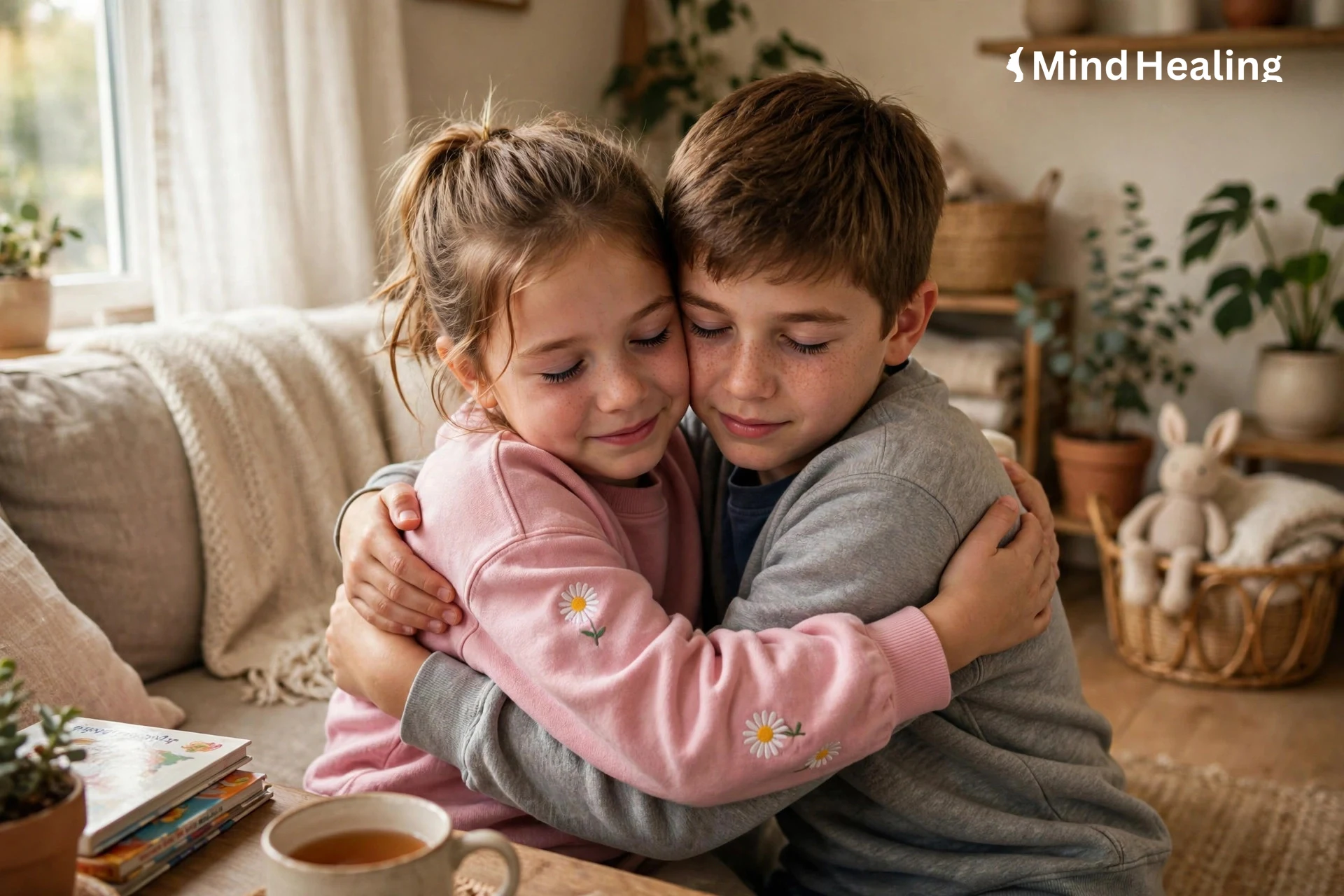
If your children seem to fight the moment you turn your back — over toys, attention, who sat where, who breathed whose air — you are not failing as a parent. Sibling rivalry is one of the most universal features of family life, and decades of child-development research confirm it: most siblings clash regularly, and it does not mean they will not love each other as adults. What matters is not eliminating every argument, but understanding why sibling rivalry happens and having practical sibling rivalry solutions that turn fights into lessons.
Key Points
- Sibling rivalry is normal and developmental — it usually peaks between ages 3 and 7 and fades as children mature.
- At its core, rivalry is about parental love and attention: each child is checking, “Am I still important to you?”
- Stop aiming for “equal” — aim for “fair and responsive to each child’s needs.”
- Intervene in fights with a calm referee script: separate, listen to both sides, help them solve it.
- Prevention beats intervention: one-on-one time with each child is the single most powerful tool.
- Step back when it is minor; step in when there is aggression, bullying, or a big age/power gap.
Why Sibling Rivalry Happens
Siblings are not just children who happen to share a house — they are competitors for the most precious resource in a child’s world: their parents’ time, attention, and approval. A new baby does not just add a family member; from the older child’s perspective, it halves their share of everything.
It is developmental, not personal
Young children are naturally egocentric — not selfish, just developmentally unable to fully see another’s perspective. A three-year-old genuinely cannot understand why her brother needs the red car right now too. As empathy and impulse control develop, usually from age 5 onward, rivalry typically softens. Knowing this helps you respond with teaching rather than anger.
Every child wants to feel uniquely loved
Rivalry spikes when a child feels compared, overlooked, or treated as “the difficult one.” The child who acts out against a sibling is often really saying, “Notice me. Am I still special to you?” This is why the most effective long-term solution is not punishment — it is making sure each child regularly feels seen as an individual.
Temperament clashes are real
Sometimes rivalry is simply chemistry: an active, intense child paired with a sensitive, quiet one will grate on each other no matter how skilled the parenting. You cannot change temperaments, but you can teach both children to navigate their differences — a skill that will serve them for life.
Fair Does Not Mean Equal
One of the biggest traps parents fall into is keeping score: same number of gifts, same minutes of screen time, same size of dessert. Children quickly learn to audit your fairness — and you will never win that game.
Meet needs, not scorecards
A seven-year-old and a three-year-old do not need the same things. Fairness means each child gets what they need: the baby needs more physical care, the older child needs more conversation and independence. Explain this openly: “Your sister needs help with her shoes because she is three. You needed the same help when you were three — now you get bigger-kid privileges.”
Stop announcing equality
Every time you say “I love you both exactly the same,” children hear a comparison being made. Instead, show individual love through individual attention. A child who got 15 minutes of your undivided time building Lego does not need to compete for your affection at dinner.
How to Intervene: The Referee Script
When a fight erupts, your goal is not to determine who started it — it is to calm the storm and coach the skills. Try this sequence:
1. Separate and cool down
If voices are raised or anyone is physical, separate them first. “We need a pause. You sit here, you sit there.” Do not try to reason with flooded brains — wait until everyone, including you, is calm. This is the same cool-down principle behind talking so kids actually listen: connection before correction.
2. Listen to both sides — without taking sides
Hear each child out: “Tell me what happened from your side.” Reflect back what you hear without declaring a winner. The moment you become a judge, you create a winner and a loser — and the loser files it away for the next round.
3. Help them solve it
Ask, “What ideas do you have to fix this?” Young children need heavy coaching here; older ones can brainstorm with light guidance. The goal is restitution and a plan, not punishment: “So you’ll take turns — you get it for ten minutes, then your sister. How will we remember when to switch?”
4. Follow up with connection
After the storm, reconnect with each child individually. A quick hug, a shared joke, a “we got through that” reminds them the relationship with you — and with each other — is bigger than one fight.
Prevention: Fill Their Cups First
The best fight is the one that never starts. Rivalry drops dramatically when each child’s emotional needs are met proactively.
One-on-one time is the superpower
Even 10–15 minutes a day of child-led, distraction-free time with each child works wonders. Let them choose the activity. No teaching, no correcting — just delight in them. Children who feel securely connected to you have far less need to compete with their siblings for proof of your love.
Create teamwork, not competition
Give siblings shared missions: build a fort together, cook a meal together, solve a puzzle as a team. Shared fun builds the “us” feeling that rivalry erodes. And avoid pitting them against each other — “let’s see who finishes first” turns even tooth-brushing into a battleground.
Respect their separate identities
Give each child their own space, possessions, and friendships. Forced sharing of everything breeds resentment. It is okay — healthy, even — for siblings to have things that are just theirs. Discipline approaches that respect each child’s stage, like toddler discipline without punishment, also reduce the resentment that fuels fights.
What NOT to Do
Don’t compare them
“Your sister never gives me trouble” might shame one child into compliance for an hour, but it poisons the sibling relationship for years. Each comparison teaches children to measure their worth against each other.
Don’t label roles
“The responsible one,” “the wild one,” “the baby” — family roles become self-fulfilling prophecies. The “wild one” stops trying to be calm because nobody expects it. Let each child surprise you.
Don’t always force apologies
A coerced “sorry” teaches nothing except how to say words without meaning them. Focus on making things right — fixing what broke, doing something kind — and genuine remorse often follows on its own.
When Rivalry Is More Than Rivalry
Normal rivalry is mutual, roughly matched in power, and forgotten quickly. Get concerned — and seek professional guidance — when you see a persistent pattern of one child dominating, humiliating, or frightening the other; physical aggression that causes injury; or a child who seems anxious, withdrawn, or dreads being alone with their sibling. That crosses from rivalry into bullying behavior, and it needs a different, firmer response.
A Note for Pakistani and South Asian Families
In joint families, sibling rivalry often comes with an audience — grandparents, aunts, and uncles who take sides, compare cousins, or intervene with their own discipline. This can supercharge conflicts. It helps to agree with elders on a simple rule: the parents handle discipline, and nobody compares children — siblings or cousins — in front of them.
Age hierarchies are also strong in our culture: older siblings are often expected to “be the bigger person” and sacrifice for younger ones. While teaching generosity is good, consistently forcing the elder to yield breeds deep resentment. Fairness means the younger child also learns to respect the elder’s turn, space, and belongings. And in families where resources feel stretched, reassure each child individually that love is not divided by being shared — it multiplies.
Frequently Asked Questions
Should I let them “work it out themselves”?
Sometimes. If the fight is verbal, low-intensity, and roughly equal, hanging back lets them practice conflict resolution. Step in when anyone gets physical, when one child is clearly overpowered, when property is being destroyed, or when the same fight repeats without resolution.
My older child resents the new baby. Is this normal?
Completely normal. Regression (baby talk, wanting to be carried), acting out, or demanding extra attention are all typical. The antidote is not scolding but filling their cup: special big-kid privileges, protected one-on-one time, and acknowledging their feelings — “It’s hard sharing Mama right now.”
How do I stop the tattling?
Teach the difference between tattling (getting someone in trouble) and telling (getting help for danger). Respond to tattling with: “Are you telling me to get help, or to get your brother in trouble?” Then redirect: “It sounds like you two need a solution — what’s your idea?”
They fight more when I’m busy or on the phone. Why?
Because it works — fighting reliably summons your attention. This is data, not defiance. The fix is proactive: give brief check-ins and connection before you need to be busy, and respond to fights with calm boredom rather than dramatic intervention.
Is it okay that they have completely different rules?
Rules should be consistent in values but flexible in application — bedtimes, responsibilities, and freedoms naturally differ by age. Explain the why: “Different ages, different rules — just like you got extra help when you were little.”
Will they grow out of it?
Mostly, yes. Research and every grandparent agree: the intensity of sibling conflict generally declines as children develop empathy and self-control, and many fiercely rivalrous siblings become close adults. Your steady, fair coaching now is what makes that later closeness possible.
Key Takeaways
- Sibling rivalry is normal, developmental, and rooted in the need to feel loved and important.
- Aim for fair, not equal — meet each child’s individual needs.
- Referee fights with the script: separate, cool down, listen to both, help them solve it.
- Prevent fights with daily one-on-one time and shared teamwork experiences.
- Never compare, label, or force insincere apologies.
- Know the line between rivalry and bullying — and act firmly if it is crossed.
- Find more strategies for calmer family life in our parenting resources.
