



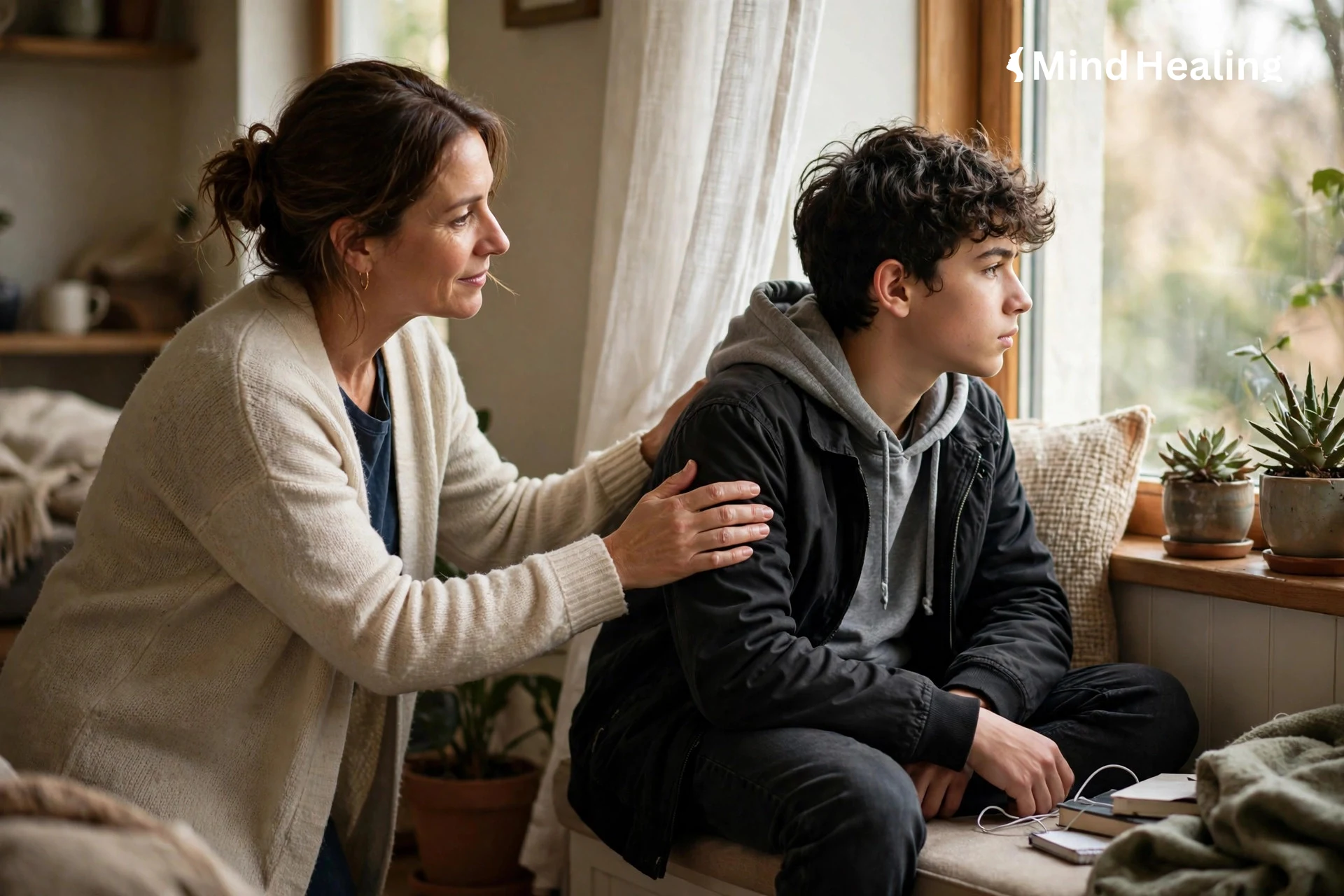
Most parents expect teenage depression to look like constant crying and teenage anxiety to look like obvious panic. In reality, the warning signs are far quieter — and far easier to miss. Irritability gets labeled “attitude.” Withdrawal gets labeled “typical teen.” Falling grades get labeled “laziness.” By the time the signs are unmistakable, many teens have been suffering silently for months. Learning to read the subtle signals early can change the entire course of your child’s struggle — because teen anxiety and depression are highly treatable when caught in time.
Key Points
- Teen depression often looks like irritability, anger, or emptiness — not just sadness.
- Teen anxiety often hides behind perfectionism, avoidance, stomach aches, and sleep problems.
- The most-missed signs are gradual: slow withdrawal from friends, dropping grades, loss of interest in things they used to love.
- Trust patterns over moments — a bad week is normal; a bad two months is a signal.
- How you respond in the first conversation determines whether they ever open up again.
- Professional help is not a last resort — earlier support means faster recovery.
Why Parents Miss the Signs
It is not negligence — it is camouflage. Teenagers are developmentally wired to hide vulnerability, especially from parents. Add in the genuine turbulence of adolescence, and real warning signs blend into the background noise of “just being a teenager.” Understanding the disguises is the first step to seeing through them.
It looks like normal teen behavior
Moodiness, sleeping in, preferring friends to family — all normal in doses. The difference is degree and duration. A teen who is occasionally grumpy is fine; a teen who has been irritable, withdrawn, or joyless for weeks is signaling something. Understanding what is normal in teenage development helps you spot what is not.
Teens hide it on purpose
Many teens fear worrying their parents, being judged, or being “fixed.” They become skilled at performing fine — good grades can coexist with deep depression. Look for the private moments: the face before the mask goes on in the morning, the energy after school, the weekends.
Parents explain it away
“It’s just exam stress.” “She’s just dramatic.” “He’ll grow out of it.” These explanations feel comforting, but they can delay help by months. When in doubt, take the signal seriously — the cost of overreacting is a conversation; the cost of underreacting can be much higher.
Depression Warning Signs That Don’t Look Like Depression
Irritability and anger instead of sadness
In teens, depression frequently wears the mask of irritability — snapping over small things, constant frustration, a short fuse with siblings. If your usually easygoing teen has become persistently prickly, consider mood, not just manners.
Withdrawal and the slow fade
The most-missed sign of all: a gradual retreat. Fewer friends over, declining invitations, spending all free time alone in their room, one-word answers at dinner. It happens so slowly that families adjust to it — until one day they realize their teen has disappeared socially.
Loss of pleasure (anhedonia)
The cricket-mad teen who stops playing. The artist who abandons drawing. When activities that once lit them up now get a shrug, pay attention. This quiet loss of joy is one of the most reliable markers of depression.
Physical complaints with no clear cause
Recurring headaches, stomach aches, fatigue — especially on school mornings — can be depression or anxiety speaking through the body. If medical checks find nothing and the pattern persists, consider the mind.
Grades slipping and motivation vanishing
A sharp drop in school performance, missing assignments, “I don’t care” about results — depression drains the energy that motivation runs on. Punishing the grades without addressing the cause only deepens the hole.
Anxiety Warning Signs That Hide in Plain Sight
Perfectionism and fear of mistakes
The straight-A student who melts down over a single B, who rewrites homework for hours, who cannot tolerate being wrong — this is often anxiety, not ambition. Perfectionism looks like success from the outside while feeling like terror on the inside.
Avoidance dressed as disinterest
“I don’t want to go” to the party, the presentation, the family gathering. Anxious teens avoid what frightens them, then lose the chance to learn they could cope. Each avoided situation shrinks their world a little more.
Sleep disruption and restlessness
Trouble falling asleep with racing thoughts, nightmares, or sleeping far too much to escape the day — sleep is one of anxiety and depression’s earliest casualties. Chronic sleep problems in a teen deserve attention, not just an earlier bedtime.
Reassurance-seeking and “what if” spirals
Endless questions — “what if I fail?”, “what if they hate me?” — and needing constant reassurance that never quite sticks. This is the anxious brain looping, and logic alone cannot break the loop.
What to Say When You’re Worried
The first conversation is the most important one you will have. Get it right, and your teen gains an ally. Get it wrong, and the door may stay shut for a long time.
Lead with observation, not accusation
“I’ve noticed you seem really down lately, and I’m worried about you because I love you” opens doors. “What’s wrong with you? Why are you always in a bad mood?” slams them. Describe what you see, name your love, and invite — never demand — a response.
Listen without fixing
Your teen does not need solutions in the first conversation — they need to feel heard. Reflect back what you hear, ask gentle follow-ups, and resist the urge to minimize (“everyone feels like that”) or catastrophize. Sometimes teens also face cruelty from peers; knowing the signs of bullying can help you ask the right questions.
Normalize help, don’t dramatize it
“Talking to someone who knows about this stuff helped a lot of people — it’s like a coach for your mind” normalizes counseling. “We need to get you to a doctor immediately” can terrify a teen into denial. Keep it calm, practical, and hopeful.
Ask directly about self-harm and suicidal thoughts
This is the hardest question and the most important one. Asking does NOT plant the idea — research consistently shows it opens the door to honesty. Calmly: “Have you ever felt so low you’ve thought about hurting yourself?” If the answer is yes, stay calm, take it seriously, and get professional help promptly.
When and How to Get Professional Help
You do not need to wait until things are severe. A good rule: if concerning signs persist beyond two to four weeks, or if they interfere with school, friendships, or daily life, consult a professional.
Where to start
A family doctor or pediatrician is a reasonable first step to rule out medical causes. From there, a psychologist or counselor experienced with adolescents can assess and guide treatment. Many teens do well with talk therapy alone; some benefit from a combined approach. In Pakistan, university psychology clinics and growing online therapy options have made adolescent counseling far more accessible — ask for a therapist experienced with teens specifically.
What treatment looks like
For teens, therapy often includes cognitive-behavioral tools (managing thoughts and behaviors), family sessions (because the home environment matters enormously), and school coordination when needed. Progress is usually gradual — expect small, steady improvements rather than overnight transformation.
Your role in recovery
You are part of the treatment team. Keep routines steady, reduce unnecessary pressure (this is the time to ease off on the extra tuition, not add more), celebrate small wins, and take care of your own mental health too. A calm, supported parent is the best medicine a struggling teen can have.
Supporting Them Day to Day
Beyond professional help, daily life at home shapes recovery enormously.
Keep connection alive
Depressed teens push people away — which is exactly when they need people most. Keep showing up gently: shared meals, a walk together, interest in their world. Don’t take the rejection personally; it is the illness talking, not your child.
Protect sleep, movement, and sunlight
The basics matter more than they seem. Regular sleep, daily physical activity, and daylight exposure genuinely improve mood — they are not cures, but they are foundations that make everything else work better.
Prepare for the long road to adulthood
Recovery builds resilience that serves them for life. As they stabilize, gradually return responsibility and independence — the goal is a young adult who knows how to manage their mental health. Preparing teens for adulthood includes teaching them to recognize their own warning signs and ask for help early.
A Note for Parents in Pakistan and South Asia
Here, stigma is often the biggest barrier — bigger than access. Many families fear that seeking help labels the child or shames the family. Reframe it: getting support for your teen’s mind is no different from getting a tutor for a weak subject. It is responsible parenting, not failure. Academic pressure in our system is a real contributor to teen anxiety; if your teen is drowning under expectations, easing the pressure is treatment, not surrender. Confidential counseling in Urdu is increasingly available, including online. Explore more parenting guidance written for our context.
Frequently Asked Questions
How do I tell normal teen moodiness from depression?
Look at duration, intensity, and impact. Normal moodiness comes and goes and doesn’t stop them functioning. Depression persists for weeks, is markedly worse than their baseline, and interferes with school, friendships, or family life. When in doubt, trust the pattern.
My teen refuses to talk to a counselor. What now?
Don’t force the first session as a punishment. Offer choices (“would you prefer a male or female counselor? online or in person?”), share that many teens find it surprisingly helpful, and consider starting with family sessions. Sometimes a trusted teacher or relative can bridge the gap.
Can anxiety and depression go away on their own?
Mild, short-lived dips often resolve. But persistent anxiety or depression rarely disappears without support — and waiting risks it deepening. Early help leads to faster, more complete recovery.
Should I tell the school?
Often yes, with your teen’s knowledge. Schools can offer accommodations — extended deadlines, counseling support, reduced load during crisis periods. Frame it as teamwork, not tattling, and involve your teen in deciding what gets shared.
Is medication necessary for teens?
Not always — many teens recover with therapy, lifestyle changes, and family support alone. Medication is a medical decision made with a qualified psychiatrist, weighing benefits and risks for that specific teen. Never start, stop, or adjust medication without professional guidance.
What if my teen says “I’m fine” but I know they’re not?
Believe your eyes over their words. Say: “You don’t have to talk about it right now, but I’m here, I love you, and I’ve noticed you seem to be struggling. We can figure this out together.” Then keep the door open and keep observing.
Key Takeaways
- Teen depression often looks like irritability and withdrawal; teen anxiety hides behind perfectionism and avoidance.
- Watch for gradual patterns — the slow fade from friends, joy, and motivation matters more than one bad day.
- Lead with love and observation, never accusation, in the first conversation.
- Ask directly about self-harm — it opens honesty, it doesn’t plant ideas.
- Get professional help early; you don’t need to wait for a crisis.
- In our context, fight stigma by framing help-seeking as responsible parenting.
