



Key Points
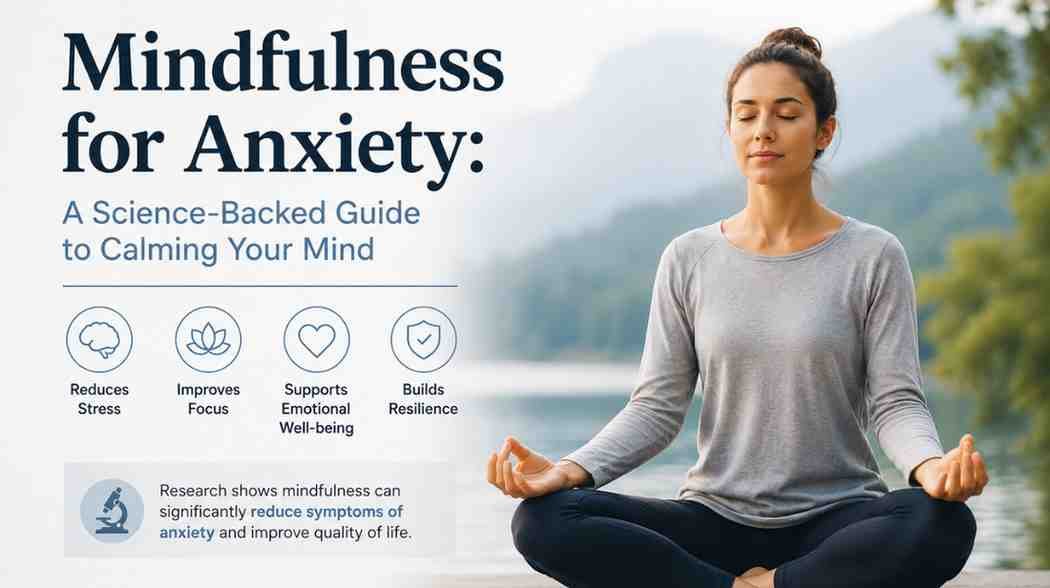
- Mindfulness for anxiety breaks the cycle of rumination by anchoring your mind in the present moment, so it stops spiraling into worst-case scenarios.
- Scientific research confirms that mindfulness physically shrinks the amygdala, the brain’s fear center, while thickening the prefrontal cortex responsible for calm decision-making.
- Regular practice activates the parasympathetic nervous system, lowering your heart rate, blood pressure, and cortisol levels.
- Practical techniques like mindful breathing and body scans deliver immediate, measurable relief during anxiety spikes.
- Combining mindfulness with NLP and energy healing creates a comprehensive, multi-layered path to long-term mental resilience.
Anxiety often feels like a storm that never ends. It pulls your mind into a future that has not happened yet. It traps you in a relentless cycle of “what if” scenarios that drain your energy and steal your peace.
Mindfulness offers a way to step out of that storm. It is not about stopping your thoughts. It is about changing how you relate to them. Instead of being swept away by every fearful thought, you learn to observe it, acknowledge it, and let it pass. This is exactly why mindfulness for anxiety has become one of the most trusted tools in modern emotional healing.
Welcome to this space for healing and growth. I am Dr. Ghazala Tahir, founder of Mind Healing Ghazala.
With over a decade of experience in life management coaching, neuro-linguistic programming (NLP), hypnotherapy, and energy healing, I have dedicated my career to helping individuals navigate the complex intersection of mental health and human connection.
I understand that anxiety is not just an internal struggle. It is an active force that shapes how you interact with the people you love most. It changes how you show up at work, how you respond to your children, and how you experience your own body.
My goal is to give you authoritative, experience-based insights that move beyond surface-level advice.
Whether you are struggling in a romantic partnership, finding it difficult to maintain friendships, or simply trying to get through the day without being consumed by worry, this guide will help you understand the “why” behind these challenges. It also offers actionable, expert-backed solutions for 2026.
Understanding Mindfulness and How It Relates to Anxiety
Mindfulness is the practice of paying attention to the present moment without judgment. You observe your thoughts as they arise, without becoming overwhelmed by them or reacting impulsively.
This practice works powerfully for anxiety because it directly interrupts the cycle of excessive worry. By focusing on the “now,” you stop your mind from wandering into fearful projections about the future or painful replays of the past.
How Mindfulness for Anxiety Works
Mindfulness manages anxiety in three key ways.
First, it stops the habit of rumination. Instead of overthinking the same worry for hours, you learn to see thoughts as temporary mental events. They come, they exist for a moment, and they go. You do not have to chase every one of them.
Second, it regulates your stress response. When you stay present, you send a clear signal to your body that you are safe in this exact moment. Your body responds by easing out of the fight-or-flight state.
Third, it enhances emotional awareness. You become a witness to your feelings rather than a victim of them. This shift in perspective lets you respond to situations with clarity instead of reacting out of fear.
The Science Behind Mindfulness and Anxiety
This is not theory. This is neuroscience. Research consistently confirms that mindfulness creates real, measurable changes in the structure and function of the brain. These changes directly affect how we process fear and stress.
Changes in the Brain
Neuroimaging studies show that regular mindfulness practice increases activity and cortical thickness in the prefrontal cortex. This area governs emotional regulation, rational thinking, and decision-making.
At the same time, mindfulness decreases activity and volume in the amygdala. This is the part of the brain that triggers the fight-or-flight response. A large population-based study published in Brain Imaging and Behavior, drawn from the Rotterdam Study and involving 3,742 participants, found that meditation and yoga practice was associated with significantly smaller right amygdala volume.
As Scientific American explains, after an eight-week course of mindfulness practice, the amygdala appears to shrink while the prefrontal cortex becomes thicker. The connection between the amygdala and the rest of the brain weakens. Meanwhile, the connections between areas linked to attention and concentration grow stronger.
2025 Research Update: A study from the Icahn School of Medicine at Mount Sinai used advanced invasive neural recording techniques to study meditation’s effect on the brain. Researchers found that loving-kindness meditation is associated with changes in beta and gamma brain waves. These are the same types of brain waves that are disrupted in mood disorders like depression and anxiety.
2026 Research Update: A widely reported study published in the journal Neuroscience of Consciousness examined 12 Buddhist monks with an average of roughly 15,000 hours of meditation experience. The findings revealed that meditation does not quiet the brain. It heightens cerebral activity, increases brain complexity, and shifts the brain toward “criticality.” This is an optimal balance between order and chaos that makes the brain more alert, flexible, and efficient.
Mindfulness and the Nervous System
Mindfulness activates the parasympathetic nervous system. This is your body’s natural “rest and digest” mode, the opposite of the fight-or-flight response.
Engaging this system lowers your heart rate and blood pressure. It reduces cortisol production and eases physical symptoms like muscle tension, shallow breathing, and digestive distress.
A recent review published in the European Journal of Radiology confirmed that Mindfulness-Based Stress Reduction (MBSR) increases functional connectivity between the ventromedial prefrontal cortex and the amygdala. In simple terms, the “thinking brain” gains more control over the “fear brain.”
2025 Research Update: Researchers at UC San Diego found that an intensive mind-body retreat combining meditation and healing practices produced rapid changes in brain function and blood biology. Participants showed reduced mental chatter, enhanced neuroplasticity, and activation of natural pain-relief pathways, all within a single week.
Practical Mindfulness Techniques for Daily Life
You do not need a quiet mountaintop or an hour of free time to practice mindfulness. These techniques fit into a busy 2026 routine, and you can do them anywhere.
Mindful Breathing
This is the quickest and most accessible way to calm your nervous system. Focus entirely on the sensation of air entering and leaving your body.
Breathe in slowly through your nose for four counts. Hold for four counts. Exhale through your mouth for six counts. Repeat this cycle five times.
If your mind wanders to a worry, gently bring it back to the breath without judgment. This anchors you in the present second and tells your nervous system that you are safe.
Body Scan Meditation
Lie down in a comfortable position and mentally scan your body from head to toe. Notice any areas where you hold tension, such as your jaw, your shoulders, or your lower back.
Consciously breathe into those areas and allow the muscles to soften and release. This practice is especially powerful when your thoughts feel scattered and you need to reconnect with your physical body.
Expert Tip: I often recommend body scans to clients who carry their anxiety in their body. Many people do not realize they are clenching their jaw or tightening their shoulders until they deliberately pay attention.
Mindful Walking
You can practice this while walking to your car, through a park, or down a hallway. Pay full attention to the feeling of your feet touching the ground with each step.
Notice the rhythm of your legs, the temperature of the air on your skin, and the sounds around you. Shifting your focus to your senses pulls you away from anxious thoughts and into the present reality.
Loving-Kindness Meditation
This involves silently repeating phrases of compassion for yourself and others. You might say, “May I be safe. May I be healthy. May I be at peace.” Then extend those same wishes to someone you love, then to a neutral person, and finally to someone you find difficult.
Practicing this daily reduces the social fear and self-criticism so often tied to chronic anxiety. It builds a foundation of internal kindness that makes the world feel less threatening. The Mount Sinai research above found that this exact practice changes brain wave patterns in the amygdala and hippocampus, two regions deeply involved in fear and memory processing. The ability to willfully control these brain waves through meditation could carry profound implications for treating mood disorders.
Micro-Mindfulness: The 2026 Approach
You do not have to meditate for 30 or 40 minutes to see results. Recent research supports the idea that short, consistent bursts of mindfulness often work better than long, infrequent sessions.
Try these micro-practices throughout your day:
- The Morning Edge: Before reaching for your phone, sit on the edge of your bed for 60 seconds. Feel your feet flat on the floor and set one intention for the day.
- The Transition Reset: Before entering your home after work, take three deep breaths in your car or at your door. Consciously drop the stress of the day before you step inside.
- The Digital Sunset: Use the last five minutes of your workday to close your tabs, both digital and mental. Take a moment to acknowledge what you accomplished.
The Long-Term Benefits of Regular Practice
Mindfulness provides immediate calm during an anxiety spike. Yet its true power lies in consistency. Regular practice builds a resilient mind that can handle stress without spiraling.
Improved Emotional Regulation
Over time, you begin to notice the “gap” between a trigger and your reaction. In the beginning, that gap might be a fraction of a second. With practice, it grows wider. In that gap, you find the power to choose a calm, deliberate response instead of reacting from fear.
From an NLP perspective, this is where we “recode” the automatic patterns that drive anxious behavior. Mindfulness creates the space for that recoding to happen naturally.
Enhanced Overall Well-Being
Mindfulness promotes a general sense of clarity, ease, and emotional balance. It improves your mood, deepens your sleep, and helps you feel more connected to your surroundings and the people in your life.
Over months and years, this compounds. You are not just managing anxiety anymore. You are building a fundamentally different relationship with your own mind.
A Word of Caution: When Mindfulness Is Not Enough
Mindfulness is a powerful tool, but it is important to be honest about its limits. It is part of a larger healing journey, not a cure-all.
A 2025 study published in Clinical Psychological Science and highlighted by the Association for Psychological Science found that nearly 60% of meditators experienced some kind of unexpected side effect, and about a third found those effects distressing. For some individuals, sitting with their thoughts can temporarily increase anxiety, trigger intrusive memories, or cause feelings of dissociation.
This is not a reason to avoid mindfulness. It is a reason to approach it with guidance and self-compassion, especially if you have a history of trauma.
Red Flags: When to Seek Professional Support
It is time to reach out for expert help if you notice any of these signs:
- Your anxiety continues to worsen despite daily mindfulness practice.
- You experience physical symptoms like severe headaches, chest tightness, or chronic digestive issues that have no medical explanation.
- You find yourself avoiding important responsibilities, relationships, or social situations because the fear is too intense.
- You feel a sense of hopelessness or find yourself relying on substances to quiet your mind.
If any of these resonate, mindfulness alone is not enough. A professional who understands both the science of the brain and the art of healing can help you build a personalized recovery plan.
Frequently Asked Questions
1. Can mindfulness really change my brain?
Yes. Multiple neuroimaging studies confirm that consistent mindfulness practice increases gray matter in areas related to emotional control and decreases volume in the amygdala. A 2026 study on Buddhist monks showed that meditation profoundly alters brain dynamics, increasing neural complexity and cognitive flexibility.
2. How long should I practice each day?
Even 10 to 15 minutes of focused mindfulness can make a significant difference in your daily stress levels. Research increasingly supports the idea that short, consistent sessions, even five minutes, are more beneficial than occasional long ones. The key is daily consistency, not duration.
3. Do I have to sit still to be mindful?
Not at all. You can be mindful while walking, eating, washing dishes, or even having a conversation. The practice is about directing your full attention to whatever you are doing in the present moment. It is not about sitting in a specific posture.
4. Can mindfulness replace medication for anxiety?
Mindfulness is a powerful complement to treatment, but it is not a replacement for medication if your doctor has prescribed it. Many people find success through a combination of mindfulness, lifestyle changes, therapy, and NLP. We always work in harmony with medical professionals to find the right balance for each individual.
5. What if meditation makes my anxiety worse?
This can happen, and it does not mean you are doing it wrong. Some people, especially those with trauma histories, find that sitting quietly with their thoughts initially increases distress. If this happens, start with movement-based mindfulness like mindful walking or gentle yoga, and work with a trained professional who can guide you safely.
Key Takeaways
Mindfulness is a cornerstone of modern anxiety management. It does not ask you to stop thinking. It teaches you to stop being controlled by your thoughts.
The science is clear. Regular practice physically reshapes your brain. It strengthens the circuits responsible for calm decision-making and weakens the circuits that trigger unnecessary fear responses.
When you build breathing exercises, body scans, and micro-mindfulness practices into your daily life, you create a stronger, more resilient nervous system. Consistency is the key to lasting change.
But mindfulness is most powerful when it is part of a larger, personalized healing strategy. Combined with NLP, hypnotherapy, and energy healing, it becomes a comprehensive toolkit for reclaiming your peace of mind.
I am Dr. Ghazala Tahir, and I have seen how mindfulness can transform a life of fear into a life of peace. You do not have to sit alone with your anxiety.
Ready to dive deeper into your healing journey? Visit me at MindHealingGhazala.com for personalized coaching that blends NLP, mindfulness, and energy healing into a path designed specifically for you.
Your journey to a calmer mind starts with a single, mindful breath. I am here to guide you every step of the way. 🤍

2 Comments
Pingback: Lifestyle and Anxiety: Daily Habits That Calm Your Mind in 2026 - Mind Healing Ghazala
Pingback: Anxiety in Children: Signs, Causes & Help (2026 Guide) - Mind Healing Ghazala